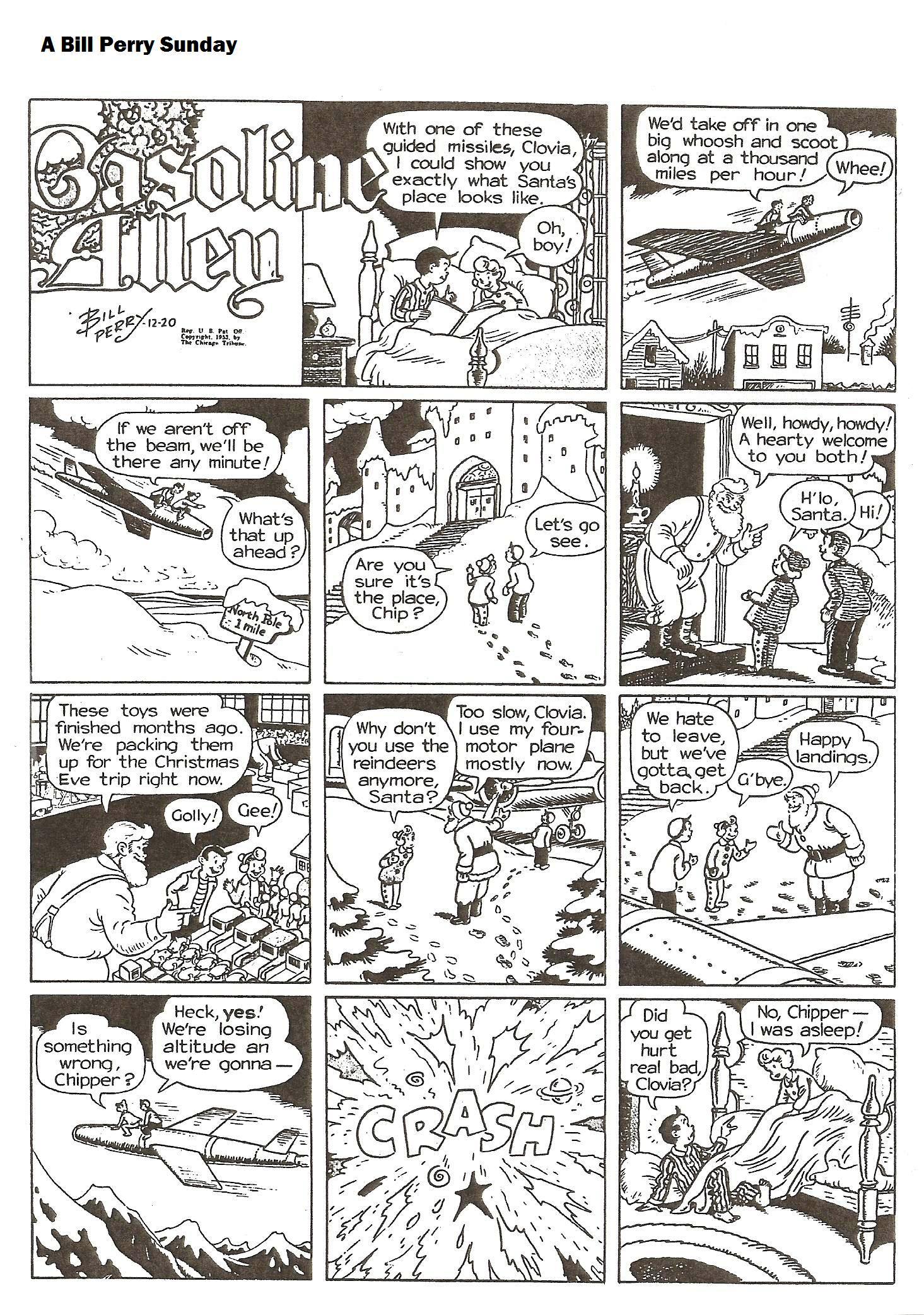
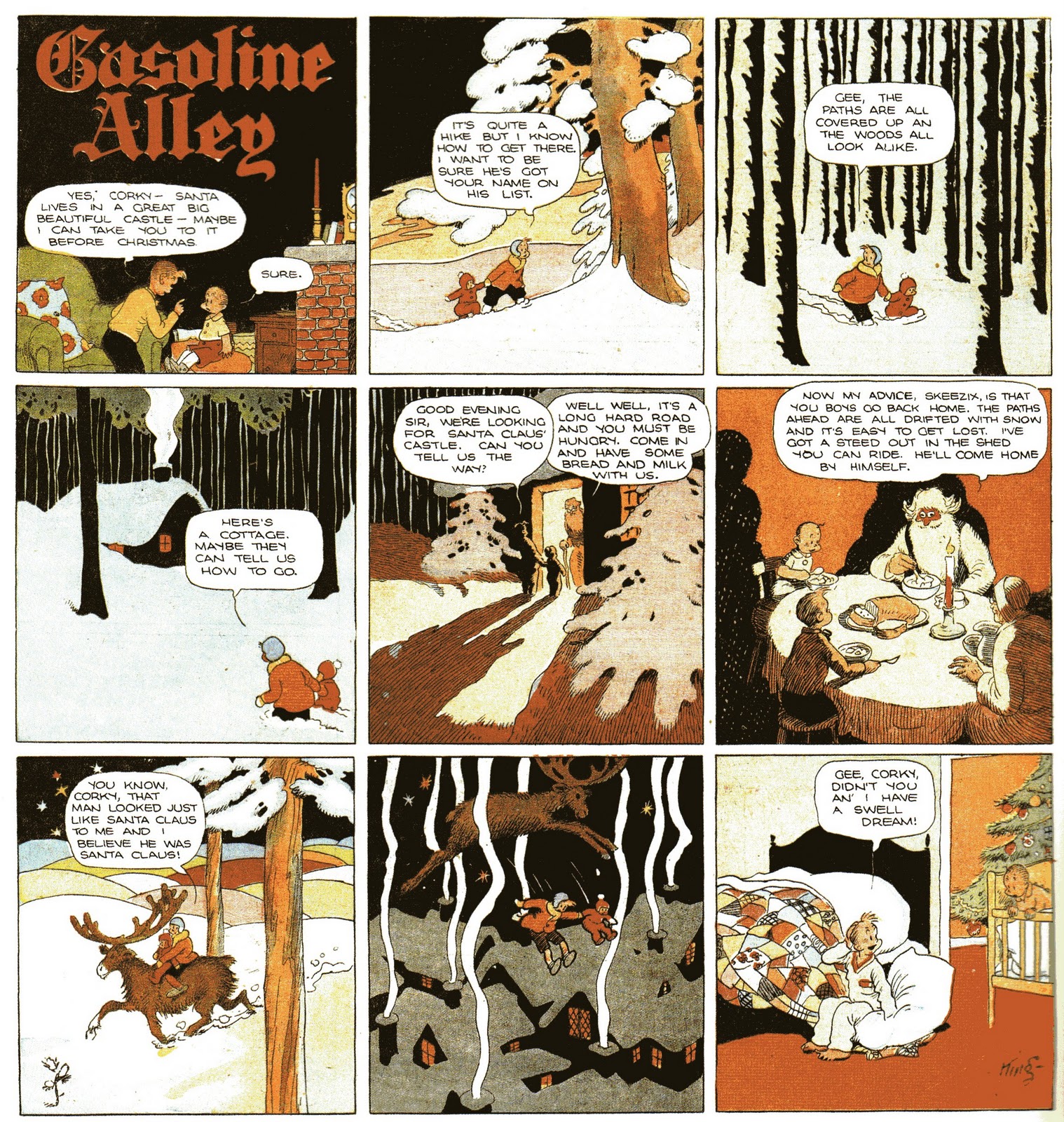
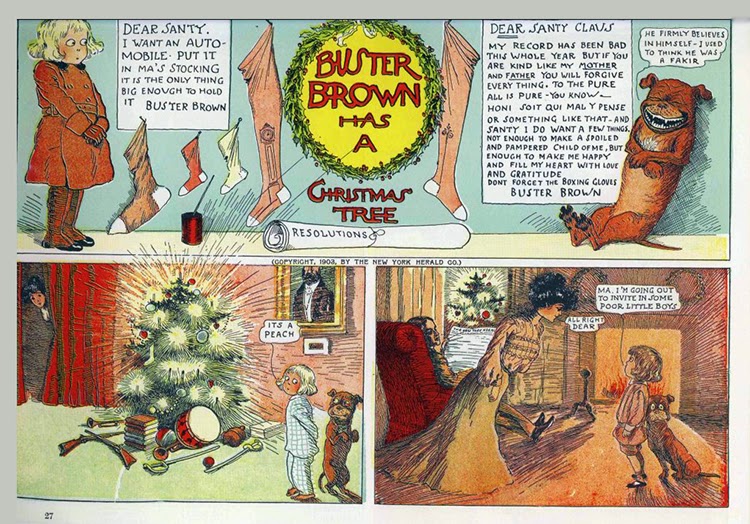
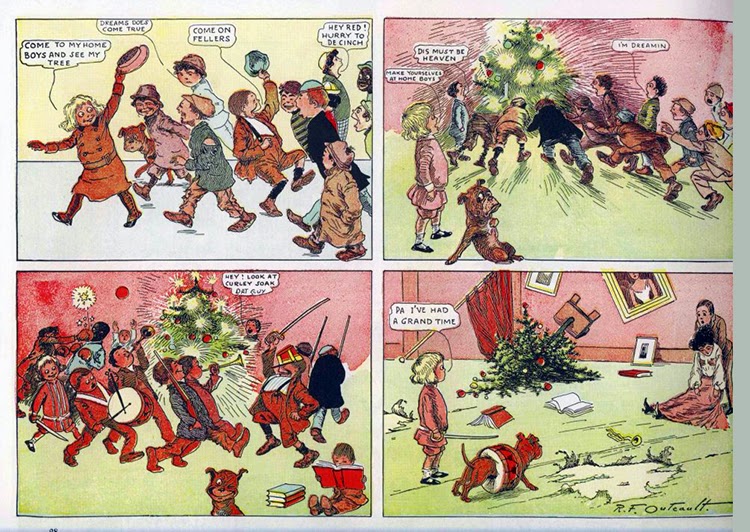
Comic Strip History - Newlyweds

One of the interesting things to me about the history of comic strips is the affect that they've had on the English language. I've written about how a cartoonist's name has made it into the dictionary, about how strange holidays have been created and named in comic strips, but actual words being coined in comic strips is a different thing. It has happened a few times, though.

I stumbled across an interesting fact when reading about the George McManus creation The Newlyweds this week. George McManus is better known for his creation Bringing Up Father, but this earlier strip is interesting in that its title makes use of a word that had not yet been in common usage.

The Newlyweds, also called The Newlyweds and Their Baby after they had one, was about a couple who had, as the title suggests, not been married long. Their names were Mr. and Mrs. Newlywed, so the title refers to a proper noun, not the common noun that we know today. It wouldn't have been a common noun, because the strip began in 1904, and at that time the term newlywed was only used as an adjective. In doing a little more research about this, Dictionary.com dates the first use of the word "newlywed" as a noun to around 1915-1920. Merriam-Webster dates the first usage a bit earlier, to 1908. The comic strip had been around for at least four years at that time. This makes it very possible that the comic strip was a very early, if not the first, usage of newlywed not only as a noun, but as a plural noun. The Online Etymology Dictionary says as much:

also newly-wed, 1907, from newly + wed. Probably owes its origin to a then-popular newspaper comic strip, "The Newlyweds and Their Baby," about Mr. and Mrs. Newlywed, by George McManus in the New York "World." As an adjective, newly-wed is attested from 1833.

Very interesting. I know of some other words that were either coined or popularized by comic strips, which I plan to write on later, but it's great to see that it was happening even from their very early days.

Additional info:

The Newlyweds at Toonopedia

George McManus at Comiclopedia

The "I" In Comic Strip Lettering

Years ago, I made a mistake.

It began when I found out something that, at the time, I couldn't believe I didn't know and hadn't noticed up to that point. It came from a post on the Zukahnaut blog, by Ötty Justason, where there was a handy image explaining how the capital "I" should be written when lettering comic strips and comic books. The blog is no longer there, but it can still be accessed on the Internet Archive Wayback Machine.

The Trickiest Letter

Basically, the normal "I," without crossbars on the top, should be used in most circumstances, and the crossbar version of "I" should only be used in very specific cases, normally if it's a personal pronoun, the first letter of someone's name, or in an acronym.

Someone I followed on Twitter retweeted this, and I was a bit skeptical, as I had never heard of this rule before. I used the crossbar version of the "I" all the time, in drawing comics as well as in normal handwriting. At the time I regulary drew a webcomic called The Bird Feeder, and I even created a font for use with the comic, based on my normal handwriting, which included only the crossbar version. I replied to him asking if this was a new rule that he'd come up with, or if it was some hard and fast rule that was in wide usage. He said it had been around for at least a century. My response was that comic art has evolved quite a bit in the past century, so it stands to reason that rules from a hundred years ago could be reexamined. I didn't see a problem with the crossbar version, and as long as the text is readable and you can get across what you're trying to say, it shouldn't matter. As a cartoonist, I figured I could just ignore the rule as well as anyone who called me on it.

This was a mistake, and he probably thought I sounded like a complete idiot. After further research I would find out how much of a mistake it was, and how much of an idiot I was.

Read more…

Comic strip history - Costumed Heroes

Most people think that the dawn of the superhero and the costumed crime fighter was in 1938 and 1939, when comic books started appearing and characters like Superman and Batman were first being published. The truth is that those comic book characters owe a lot to what was happening in the 20s and 30s in newspaper comic strips and are far from the first costumed heroes to appear.

Action and adventure comic strips had existed since the 20s and were quite popular. Some notable examples are Hal Foster's Prince Valiant, which began in 1937, and Milton Caniff's Terry and the Pirates, which began in 1934. The storylines spanned months and years, put the characters in real danger, and always included incredible cliffhangers. The artwork was exquisite, and in my opinion was far better than anything published in golden age comic books.

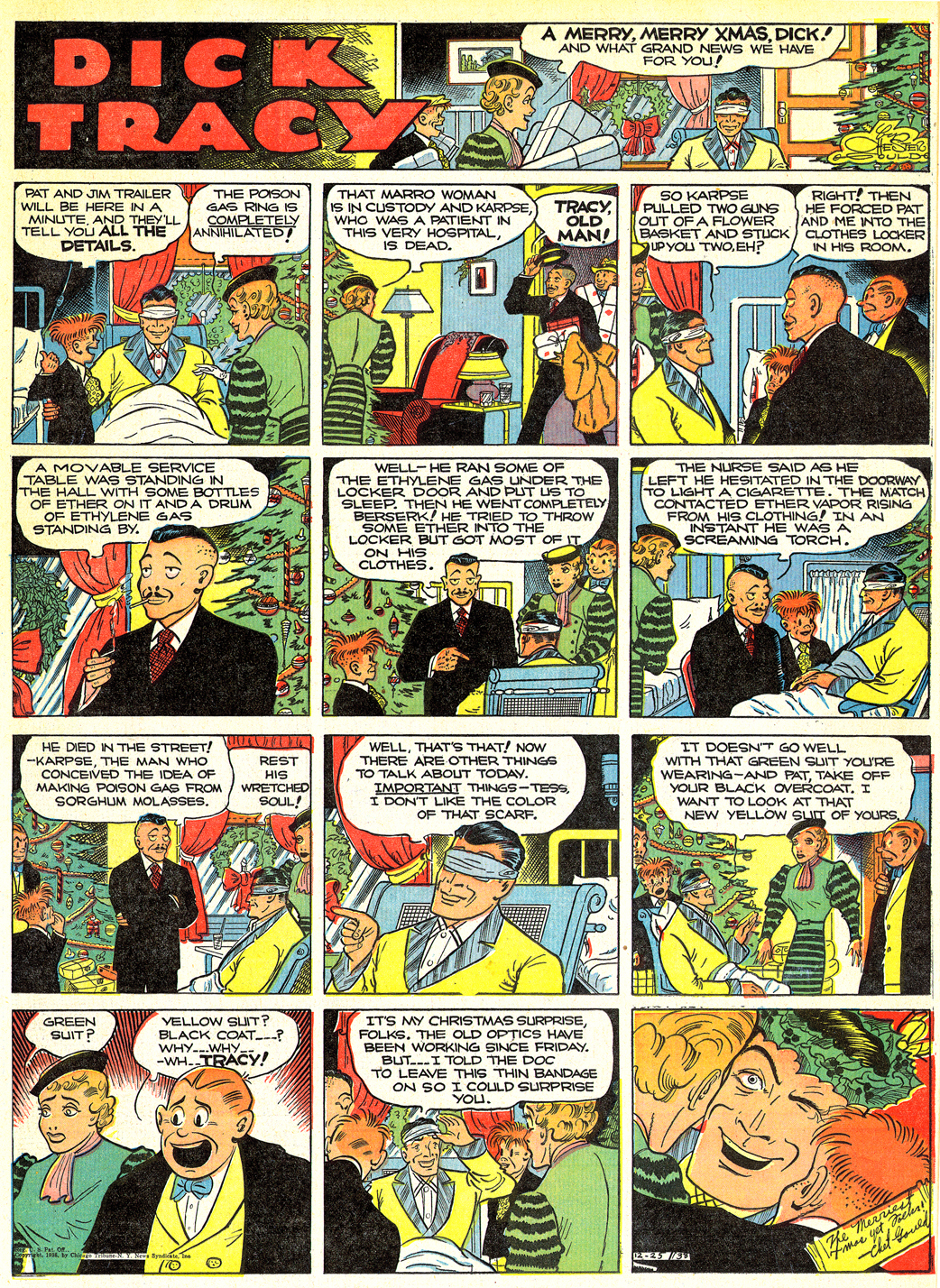
There were also what were called "crime comic strips," which dealt with policemen and even costumed vigilantes. One of the most famous crime comics was Dick Tracy, who first appeared in 1931. Created by Chester Gould, he not only fought common criminals, but also organized crime. He had his share of fancy gadgets to help him, which he used to deal with his large and very colorful rogues gallery. Not only was he doing all this 8 years before Batman arrived on the scene doing similar things, but he did it entirely in his newspaper comic strip. The only "comic books" Dick Tracy appeared in were reprints of his comic strip adventures. He didn't get a comic book with original material until the 80s.

Of course, Dick Tracy was an actual plainclothes policeman and not a costumed vigilante like Batman. The newspaper comic strip page did have Lee Falk's The Phantom, though, who was. First appearing in 1936, three years before Batman, The Phantom always wore a very distinctive costume and had a secret identity. His real name was Kit Walker, and he was 21st in a long line of men who wore the Phantom costume and fought crime.

Over time, themes from adventure comics such as the secret identity, colorful rogues gallery, skin-tight costume, and handy crime fighting gadgets would become common themes in the superhero comic book genre. They didn't start with comic books, though, but with newspaper comics. Interestingly, both Dick Tracy and The Phantom still run in newspapers today, though with different writers and artists.

More info:

Dick Tracy at Don Markstein's Toonopedia

The Phantom at Don Markstein's Toonopedia

Chester Gould at Lambiek Comiclopedia

Lee Falk at Lambiek Comiclopedia

Dick Tracy at GoComics, currently drawn by Joe Staton and written by Mike Curtis.

The Phantom at Comics Kindgom, currently drawn by Paul Ryan on dailies, Terry Beatty on Sundays, and written by Tony DePaul."

Comic Strip History - Sadie Hawkins

I'm not really a fan of dances myself, but I am aware of the phenomenon of the Sadie Hawkins dance. It's based on the idea that traditionally, at high schools and colleges mainly, boys are supposed to ask girls out to dances. Sadie Hawkins dances flip that around and require that girls ask boys to the dance. This was a thing when I was in college a few years ago, and a cursory Google search shows that it seems to still be a thing. People also still don't seem to know where it came from, though, or who Sadie Hawkins was.

Sadie Hawkins wasn't a real person, but a character that appeared in the comic strip Li'l Abner, by Al Capp. On an unspecified day in mid-November, the town where Abner lived, Dogpatch, would have Sadie Hawkins Day to commemorate her. It was said by the residents of Dogpatch that when the town was small, the mayor Hekzebiah Hawkins instituted the Sadie Hawkins Day race in order to help his daughter catch a husband. She was known as "the homeliest gal in all them hills," and had gotten to age 35 with nary a suitor. The race was instituted, all the eligible bachelors of Dogpatch were called out, and she had to chase them until she could catch one. In Dogpatch, the day was commemorated each year with a similar race, with all the young ladies of Dogpatch chasing the young men, Abner among them.

The story originally ran starting on November 15th, 1937, and was so popular that Capp ran a Sadie Hawkins strip each year. It was never specified which day was Sadie Hawkins Day, but it was always some day in November, a number of days after November 9th.

Culturally, the idea of a Sadie Hawkins race didn't catch on, but it didn't take too long for Sadie Hawkins dances to start becoming popular in colleges and high schools. The dances don't always coincide with Sadie Hawkins Day, mainly because there has been some confusion about which day that is. There is a different tradition which says that on Leap Day, February 29th, women are "allowed" to ask men to marry them, or on dates, or to dances, or whatever. The Sadie Hawkins tradition has grown together with the Leap Day tradition, and many people now call February 29th Sadie Hawkins Day. This is, however, incorrect. They are two different traditions, and Sadie Hawkins Day should be some day in mid-November.

Now, these days it seems kind of odd to have a holiday commemorating when women get to ask men out, given that it's now very common for that to happen anyway. Still, it's an interesting piece of comic strip history that amazingly made its way into the wider culture.

For more info:

Sadie Hawkins Day at Wikipedia

Sadie Hawkins Day, the animated version on YouTube

Comic Strip History - American Symbols

I probably should have thought about writing this blog post last week, but it was the July 4th celebration that got me thinking about it. There are a lot of distinctly American characters that have first appeared in comic strips and have become American icons. However, there are also prominent American symbols that first appeared in comic strips as well. Two of them were clearly popularized by a particular newspaper cartoonist named Thomas Nast.

Nast was a very prolific cartoonist. He's often given credit for creating characters such as Uncle Sam and Columbia, and though he did use them in his cartoons, he didn't create them. He also didn't popularize Uncle Sam nearly as well as James Flagg did with his Army recruitment poster.

He did, however, popularize the use of the donkey as a symbol for the Democratic party as well as begin the use of the elephant as a symbol for the Republican party. The donkey had been used before, mainly to refer to Andrew Jackson. While it originally was meant to be derogatory, Jackson adopted it for use in his campaign. Nast revived it many years later and used it as a symbol of the entire Democratic party in several of his cartoons. One notable cartoon had a donkey covered in a lion skin scaring away several other animals, one of which was an elephant labelled "The Republican Vote." Both symbols were used numerous other times, and the the parties, much like Andrew Jackson, later adopted them as official party mascots.

Nast is also sometimes credited with popularizing the "modern" image of Santa Claus as a large, bearded man in a red suit, but that's debatable and is a topic for another time.

For more info on Nast himself, see the following:

Thomas Nast at Wikipedia

Thomas Nast at Comiclopedia

Thomas Nast at the Billy Ireland Cartoon Library

For more info on the origin of the elephant and donkey symbols, see the following:

"Political Animals: Republican Elephants and Democratic Donkeys", essay from Smithsonian Magazine

The Donkey and Elephant, essay at Our White House

Comic Strip History - Believe It Or Not

When I say "Ripley's Believe It Or Not," the first thing that will probably come to most people's minds is a TV show, a museum, or even a book series. Most people will probably not think of Robert L. Ripley himself, and I'm not sure how many people know that Ripley got his start as a newspaper cartoonist.

His first full time gig was with the New York Globe as a sports cartoonist. At the time, the comic panel he drew was called Champs and Chumps, and would normally feature various sports facts and stories of amazing and unbelievable athletic feats. As time went on, Ripley would often include other interesting facts not related to sports. In the end, he dumped the sports theme entirely and renamed the panel "Believe It Or Not!"

I say he got his start as a cartoonist, because that's certainly not all that he did. Most of the other things that we associate with the "Ripley's Believe It Or Not" brand are things that Ripley himself started. His cartoons and facts were collected into several books, he opened museums and exhibitions featuring odd, unbelievable things (which he called "Odditoriums"), and he was able to appear on the first season of the Believe It Or Not TV show. Unfortunately, he died before the first season finished, but the show continued on, and all of those other things continue to this day. There are many Believe It Or Not museums around the world, there have been three different TV series, and many books are still published under the Ripley's banner. The comic panel itself also survives, now written and drawn by John Graziano.

The other interesting thing about the comic panel is that it spawned a large number of imitators, so many in fact that it became a genre unto itself. Most of the imitators concerned themselves with oddities of the local area where the newspaper was published, and they can be very interesting pieces of history if you happen to find them in old newspaper archives.

Some links for further info:

Believe It Or Not at Don Markstein's Toonopedia

Robert L. Ripley at the Lambiek Comiclopedia

The current Ripley's Believe It Or Not comic panel at Universal Uclick",

Comic Strip History - The Marx Brothers

This one's a bit more of a deep cut, but I think it's relevant. It's certainly very interesting.

I don't know how popular or well known the Marx Brothers as a whole are with most Americans these days, but from my experience Groucho Marx is a very familiar name and certainly a familiar face. At the very least, everyone knows what Groucho glasses are. They're those glasses with the big eyebrows and giant nose that you put on to look like Groucho, although the cigar is normally not included.

Now, Groucho, along with Chico, Harpo, Gummo, and Zeppo, were of course not the real names of the Marx brothers. Would you believe that the idea for their stage names came from a comic strip? Would you also believe that one of them in particular was lifted wholesale from said comic strip? It's true.

Gus Mager is best known among comic strip enthusiasts as the creator of the great strip Sherlocko The Monk. Sherlocko was, as you can guess from his name, a great detective, and he also had an assistant named Watso. Neither of them were monks in the Benedictine or Buddhist sense. "Monk" in this case is short for monkey, and Sherlocko and Watso were not the only Monks that Gus Mager drew. The very first was Knocko the Monk, who had his own strip. Others such as Rhymo, Henpecko, Braggo, Coldfeeto, Tightwaddo, Masherino, Grafto, and, yes, even Groucho joined later on and were eventually given a new strip called "The Monk Family." There were also a couple who didn't fit in with the obvious naming convention of the rest, such as Mufti and Freshy. Still, most of them began with some type of description of their character and ended in "o."

Now, the Marx Brothers themselves didn't decide to give themselves these names from the comic strip. That was done by one Art Fisher, a comedian who knew the Marx Brothers and decided to give them all nicknames based on the Monk Family naming convention. They obviously stuck, and went on to be much more famous than the comic strip they were named after.

As for Sherlocko, Arthur Conan Doyle was none too pleased with the similarity of Sherlocko's name to the name of his creation, Sherlock Holmes. Mager decided to have him renamed Hawkshaw the Detective and to have Watso renamed The Colonel. Over time, they were also both de-monkeyfied, so eventually they looked basically human.

For more info, see the articles at Don Markstein's Toonopedia, the Lambiek Comiclopedia, and at Marxology.

Comic Strip History - Rube Goldberg Machines

Okay, let's start off with an easy one. Everybody knows what a Rube Goldberg machine is, right? It's one of those things that through a convoluted series of actions and steps finally accomplishes a simple goal. A fan blows a windmill which pulls a string which makes a ball drop, etc. You've seen them. There are tons of videos on YouTube with people who have built them. In fact, just Google "Rube Goldberg" and you're likely to find more information on those machines than you are about the man himself. In fact, Rube Goldberg is literally synonymous with doing something simple by way of many convoluted steps. Really. It's in the dictionary.

But how many people actually know who Rube Goldberg was or what he did? Most people probably figure he was a guy who built weird machines. I did a search of Reddit, just because, and found a large number of posts on the "Today I learned" subreddit about people learning that Rube Goldberg never actually built any Rube Goldberg machines himself. People clearly don't know who he is or what he did.

He was a cartoonist, of course. He didn't build them. He drew them.

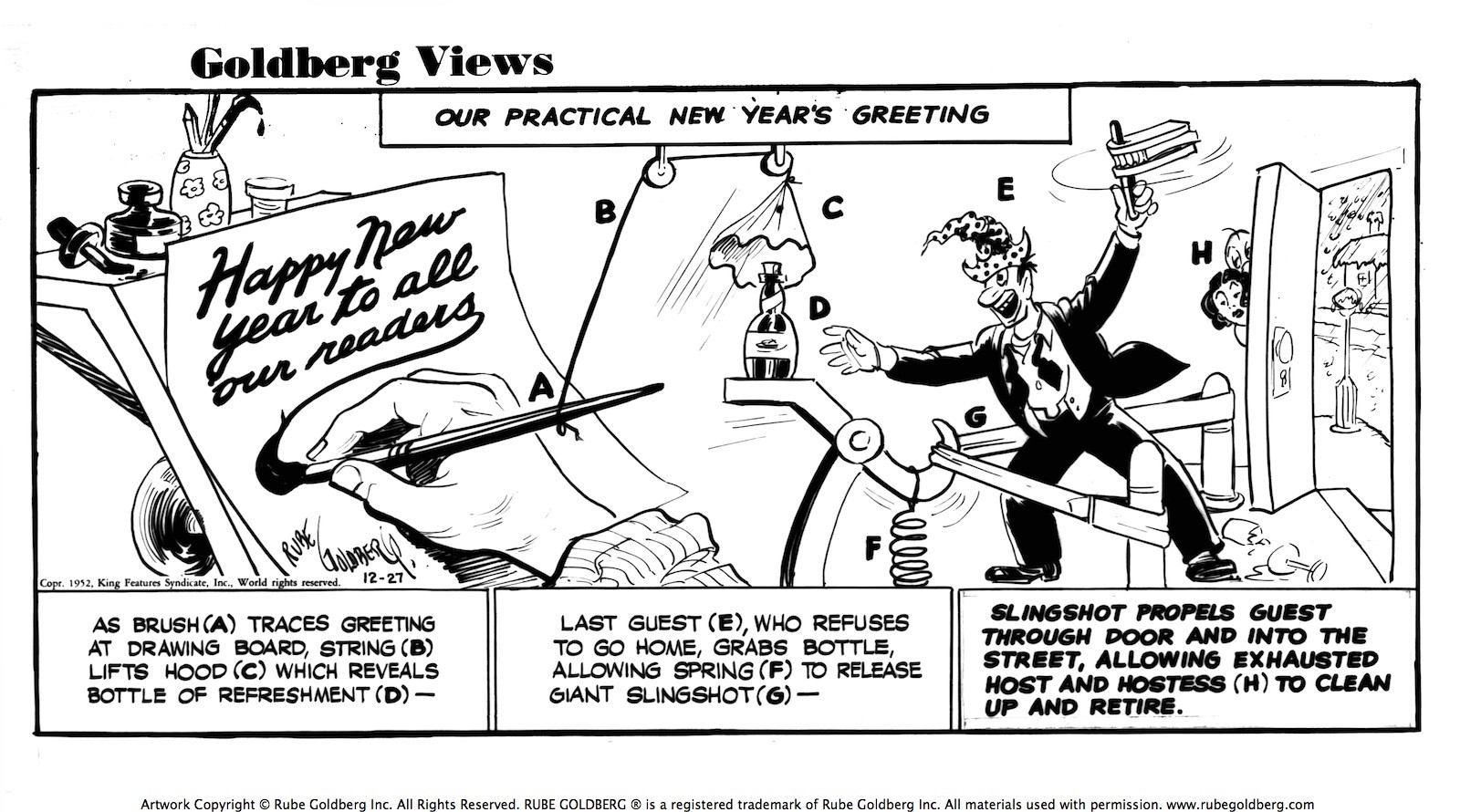
Goldberg drew a number of different comic strips (my other favorite being Boob McNutt), but the machines he is known for appeared in the strip The Inventions of Professor Lucifer G. Butts, A.K. The "G" of course stands for Gorgonzola.

The word that comes to mind when I think of that strip is "delightful." They are a joy to look at and to read. Thankfully, you can read them at your leisure at the official Rube Goldberg website, which I would highly recommend.

The most interesting thing about them, in contrast to most Rube Goldberg machines I see, is that Professor Butts' inventions were always meant to accomplish a specific task. There was always a convoluted series of steps to arrive at the conclusion, but it was always a practical conclusion. A lot of Rube Goldberg machines that you'll see in YouTube videos just go through the series of steps, but they don't do anything. A ball makes its way across the contraption, or all of the dominoes are finally knocked over, or something. I think that really goes against the spirit of a Rube Goldberg machine, or Professor Lucifer Gorgonzola Butts invention.

The other fun thing is that Professor Butts' inventions didn't only include machinery but also people, young and old, as well as animals, real and fictional. I'd like to see a YouTube video of someone integrating a snozzleduk into their machine.

But again, if you haven't yet, click here to see and read about the inventions on the official website. You won't be disappointed.

Why comic strips are important to me (and why I think they should be important to you)

I have an obsession. I'm obsessed with newspaper comic strips. I not only love reading them, but I love to study them, to study their creators, to study their history. It's fascinating to me. Unfortunately, I feel a little weird about it. It's not something that many people really seem to know about or be interested in. I know there are people that study them. Books have been written, and I've read many of them. Somebody who was interested in comic strips must have written them. But I've never met anyone in real life who really cared. I find that not only disappointing but also frustrating, as whenever I feel like having a conversation about it I have to go back to the turn of the 20th century and begin with something as simple as "Comic strips used to take up a whole page of the newspaper!" That little bit of knowledge does tend to impress people, but it's really the tip of the iceberg. There's so much more to it! There's such a deep and expansive world! It's an important part of history!

In fact, I'd posit it's one of the most neglected but most important parts of American history.

Think about it this way: For over a century newspapers with comic strips in them have been a part of the daily routine of a majority of Americans. Basically, anyone who can even rudimentarily read has read a newspaper, and those who haven't been able to read much normally find their way to the comic page where things are a bit simpler. When I say a majority of Americans, I mean it. It transcends age. It transcends race and class. While in the 21st century newspapers have steadily been on the decline, for most of the 20th century they were a major source of news as well as a major source of entertainment. The cultural impact of newspaper comics has been enormous, so enormous in fact that we often scarcely realize it.

In a way, it's kind of interesting that people don't know the real impact that comic strips have had on culture and society. It's telling when something is so ingrained in society that not only do we not know where it came from but we don't even question where it came from.

That's why comic strips are important, though, because we should know where these things came from. We should understand that cultural cliches that we all take for granted were not always so.

So, that's what I aim to change. I'm interested in comic strips and comic strip history generally, but recently I've become more interested in the cultural impact that comic strips have had. I plan to post some of those things on this blog, because I already have a few things in mind, but I'll also post more when I find them. Also, if anyone reading this blog happens to have any ideas for things I should cover because they're as obsessed with comic strips as I am, don't hesitate to chime in.

Star Wars, Firefly, and why cowboys matter

So, there's a new Star Wars movie coming out this year, and my main concern about it is the conversation that will inevitably occur around it. Not necessarily about how good it is, or how bad it is, or the speculation about future movies, or whatever. That I can handle. It basically just takes ignoring what everyone else says about it. No, I mean the conversation comparing it to previous movies, and the prequel trilogy specifically. I know it's going to happen, because it always happens. For some reason, people cannot stop talking about how much they dislike the prequel trilogy.

It's actually amazing. Most of the time, if someone doesn't like something, they'll tell you about it, and maybe give you some reasoning for why they don't like it, and if it ever comes up again, they may mention it, but it will be left at that. With the Star Wars prequels, it's completely different.

Each time the prequels are mentioned, no one is ever satisfied with just mentioning that they don't like them. Each time, they must lay out in detail exactly how disappointed they are now, exactly how disappointed they were when they came out, and each and every flaw in each of the movies. They have to go on and on about it. It's as if there's some kind of unwritten rule that each person must talk for at least 30 minutes about their dislike of the prequels whenever they're brought up. I can't count how many people I've talked with, how many online discussions I've had, and how many podcasts I've listened to where this has occurred. I can't get away from it either. In a forum or on a podcast that you would think would have nothing to do with science fiction movies of any kind, it will come up and half the podcast will just be about how bad the prequels are.

I might be okay with it if the movies were really as bad as everyone makes them out to be, but I don't see it. I see three average movies that have some flaws but also have some fun moments. There's nothing deep or overly complex about them, but there isn't supposed to be.

I've also come to the conclusion that the original trilogy can be described the same way: pretty average movies that are fun but not at all complex. Seriously, two sets of movies aren't that different. The stories don't even differ that much. Think about it: the first movie in both trilogies involves a kid from Tatooine who wants to become a Jedi, who follows a Jedi master across the galaxy to do so, and who uses his innate piloting skills and The Force to destroy a spherical space station and save everyone. One of them just has better special effects.

So, if that's the case, if they are basically the same movies, why the hate for the second set of them? What's the major difference between the sets that would cause this huge difference of opinion? It took me a while, many years in fact, to figure it out, but I finally did.

It's cowboys. The prequels don't have any cowboys.

I figured this out after thinking at length about the popularity of the TV show Firefly and its companion movie Serenity. I'm not aware of all of the reasoning behind it being cancelled after only one season, but I figure it may have to do with people not knowing how good it was when it was on the air and coming to a later realization of how good it was. They didn't know that they liked it. The same goes for Star Wars. People don't really know why they like the originals better, but they do. They like the original Star Wars trilogy better for the same reason they like Firefly. It's because of cowboys.

Firefly is basically a western set in the far future. It has all of the same elements you would expect from a good outlaw western story. Seriously, just think of your favorite outlaw western, put it in the future, replace the bad Spanish with bad Chinese, and you have Firefly. There's even a train robbery in the second episode. So, yeah, none of the characters are technically cowboys (although they do transport some cattle in one of the episodes), they're outlaws, but using the term "cowboy" for your basic western sharpshooting smooth talking outlaw type seems easiest.

Still, why does this mean futuristic sci-fi fans would like it? There's no guarantee that someone who likes sci-fi will also like westerns. In fact, it's actually a bit silly to think that anyone would, which is probably why Firefly only lasted one season. It's simple, though. Sci-fi fans already know these characters, and they know they like them, because they watched Star Wars and loved Han Solo. Ask any Star Wars fan who their favorite character is, and a majority of them will probably say Han Solo. In Firefly, nearly every character is Han Solo. You can't lose there.

In the original Star Wars trilogy, it's easy enough to split the main characters up into three groups. Obviously, you have your cowboys (Han, Chewbacca, and Lando), who everyone loves. Sharpshooting, smooth talking, and certainly outlawish. Then, you have your Jedi, who are the vaguely East Asian inspired mystical warriors. They're really just samurai. Of course, for simplicity, we'll call them ninjas, because I prefer to use a more general character cliche name. So, your good guys consist of cowboys and ninjas. Then you have the bad guys, the evil Empire, who are basically Nazis. Emperor Palpatine's rise to power strongly resembles Hitler's, and there must be a reason why all the Imperial officers are white humans while the Rebel Alliance includes several alien species as well as humans of various races. They're Nazis.

So, in the original trilogy, it was Cowboys and Ninjas VS Nazis. A winning combination, right? Right.

Now, in the prequel trilogy, there are only two groups of main characters. There are the Jedi, or the Ninjas, and then there are the Sith. Since the two major Sith lords, Palpatine and Darth Vader, end up leading the Empire, who are the Nazis, I guess I have no other choice to call them Nazi Ninjas. They're Ninjas because they are vaguely East Asian inspired mystical warriors, but they're evil and Nazi-like. So, the prequel trilogy is basically Ninjas VS Nazi-Ninjas.

But there are no cowboys. None. There is no Han Solo character in any of the movies. Sure, Chewbacca shows up, but all of the characters are either Jedi, Sith, comedy relief, politicians, expendable soldiers, or robots. No cowboys. None. All of those groups were in the original trilogy. There's only one group that isn't present in the prequel trilogy, and that's the Cowboys.

Thus, everyone hates them.

What does this mean for the future, then? Just as people didn't realize that they liked Firefly when it was first on the air, and didn't realize why they should have, I don't think people really realize why they don't like the prequels. They don't realize that the lack of cowboys is what's driving it. All the complaints I hear are about whiny Anakin or the stupid love story, when there's plenty of whiny Luke and a stupid love story in the original trilogy. As soon as we realize the cowboy factor, not only can we put a stop to those stupid arguments, but people can stop going on and on about how much they don't like the prequels. Perhaps in those long, drawn out complaints, people are searching for something. They know they don't like them, but they're not quite sure why not. Just say "No Cowboys," and it can be over.

We can also then be sure that as long as there are cowboys in any future Star Wars movies, they will be good.