Blog: comic strip history

Comic Strip History - The Grawlix

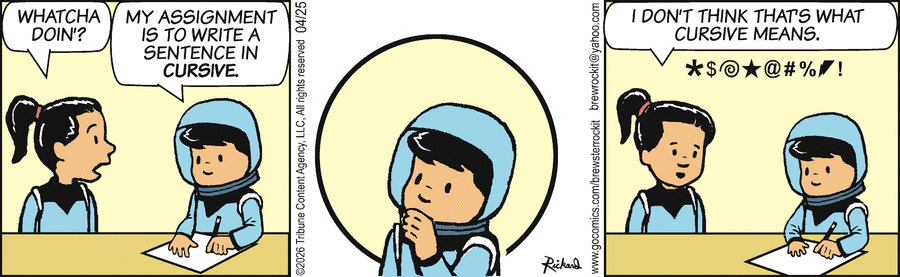
Brewster Rockit, Space Guy, April 25, 2026

In times past, when I've covered words or phrases that originated in a comic strip, generally they had a major effect only on the English language, and sometimes only American English. This time, however, we have something that appears to have affected multiple cultures and languages across the world, even while still remaining entirely unpronounceable. Everyone has seen it, and it's immediately recognizable. It's a series of punctuation marks and symbols that indicate someone or something is emitting profane or vulgar language (for example, "@&%$!"), which these days is most commonly known as a grawlix.

The first appearance of a grawlix, that we know of, was in a strip called Lady Bountiful, drawn by Gene Carr, published on November 1, 1901. Ruldolph Dirks, creator of the Katzenjammer Kids, is often cited as the first to use a grawlix, but examples of this in Dirks' work can't be found until a year after the Lady Bountiful strip. However, the popularity of the Katzenjammer Kids was certainly instrumental in popularizing its use. Given that one of the main characters of the strip was a ship captain, and the strip would often feature other characters who were sailors, they cursed just like them, too. Such cursing would, of course, be "censored" by the grawlix.

In the earliest uses, all types of symbols were included, not just punctuation marks, though the exclamation point was very common and was generally expected to appear. Other common symbols were five-pointed stars, spirals, skulls, and in the case of Dirks' sailors, an anchor. Grawlices have mainly been used in comic strips with a more humorous tone; they have always exuded a certain air of whimsy, so they may seem out of place in a strip with more serious drama. Still, they can bring a more fun and comedic air to an action and adventure strip, and cartoonists such as Harold Gray, in Little Orphan Annie, and Chester Gould, in Dick Tracy, were not afraid to employ them from time to time.

It wouldn't take long for this to become a convention in not only newspaper comics, but also comic books. In the modern age, it seems the grawlix has broken free of comics entirely, and can often be seen in various textual media, everywhere from published books to social media posts. While I'm not an Internet historian, I can also imagine it being very useful even from the early days of the Internet, back when the only way to send information of any kind was through the use of text. Further, because of the nature of it, the grawlix isn't restricted to use within any particular language. People around the world are able to use it and still be understood. In fact, the official emoji for an angry person using profanity (🤬) (officially known as "serious face with symbols covering mouth") has a censor bar with a grawlix on it.

But where did the word "grawlix" come from?

In 1946, columnist Charles Rice in the newspaper supplement tabloid This Week wrote a humorous column titled "Squeans, Plewds, and Briffits, or How to Be A Cartoonist," in which he presented several visual conventions of comic strips along with the names of such. The column was written in a way that suggested these words already existed and were in use among cartoonists, though Rice had made them all up himself. There was, however, no mention of a grawlix in Rice's column. At that time and since, one can find others using words and phrases such as "cursing characters" or "obscenicons," but "grawlix" had not yet been invented.

Squeans and Plewds

Enter Mort Walker.

Clearly inspired by Rice's column, Walker, creator of Beetle Bailey, wrote a column for the National Cartoonists Society magazine The Cartoonist entitled "Let's Get Down To Grawlixes." This column, published in 1964, cites Rice as an inspiration and includes all of the words he coined in his article for This Week, but goes even further by coining terms for many other visual conventions of the comics medium, including the grawlix. Of the grawlix, Walker wrote:

A variety of acceptable curse words are at the cartoonist's disposal. He may throw in a new one from time to time, but the real meat of the epithet must always contain plenty of jarns, quimps, nittles, and grawlixes, as shown.

In his book Mort Walker's Private Scrapbook, Walker says this article was originally meant to only be a joke, but his son Brian convinced him to expand the idea into an entire book. In 1980, this would become the seminal reference work for all of these comic words, The Lexicon of Comicana.

As a side note, despite citing Rice as an inspiration in the The Cartoonist article, in Private Scrapbook Walker claims to have invented all of the words he included in the Lexicon which, as has been shown, is not true. Many of the words both in the The Cartoonist article and in the Lexicon were borrowed from Rice, and in the Lexicon Walker even recreated Rice's illustrations of plewds and squeans, complete with Rice's captions. That said, in his book Backstage At the Strips, Walker begins by writing, "If the stories in this book are not exactly told the way they happened, it's the way they should have happened if God had been a better gagwriter -- or if I'd had a better memory." So I guess that applies to Private Scrapbook as well.

Squeans

Plewds

But I digress. In The Lexicon of Comicana, in a section of the book titled "Maladicta," Walker introduces the grawlix and its relatives in a way similar to their introduction in the The Cartoonist article:

Even in today's permissive society many four letter words are not permissible in the comics. Even though profanity may be used in other sections of the paper, people feel that, since children read cartoons, the comic section should be inviolate. Cartoonists, therefore, have had to develop acceptable substitutes. A first sergeant would lose a lot of his charm if he said, "Gee whiz, Beetle. You make me so terribly mad!" So the creative mind came up with a variety of "jarns," "quimps," "nittles," and "grawlixes" to help convey a sergeant's strong emotion and add color and dimension to his personality.

Jarns, Quimps, Nittles, and Grawlixes

It's interesting to note that, in both the The Cartoonist article and in the Lexicon of Comicana, Walker names a number of different profanity replacements consisting of various shapes and symbols, the grawlix only being one of many. A jarn appears to include only spiral type shapes, a nittle includes various star shapes, and a grawlix appears to only consist of formless squiggles. Yet, "grawlix" would be the word that would come to describe all of these varying maladicta over the course of time. This may have been because it's the most interesting and memorable of the words, or perhaps because Mort Walker himself decided to lump them all together at some point. I can't be sure.

Whatever the reason, by 2018 dictionaries had begun to take notice of widespread enough use of the word that they started including it. Webster's added it in 2018, the official Scrabble dictionary added it in 2022, and the venerable Oxford English Dictionary added it in 2025.

For more information:

Obscenicons A Century Ago and More on the early days of obscenicons at Language Log

Grawlixes Past and Present by Gwillim Law

Charles Rice's column in This Week at Weird Universe

Backstage At The Strips and Mort Walker's Private Scrapbook at The Internet Archive

What the @#$%&! Is a Grawlix? at ThoughtCo.

What the #@*% is a ‘grawlix'? at Merriam-Webster

Why Cartoon Characters Curse Like This at the Vox YouTube channel

Grawlix and the Lexicon of Comicana at A Way With Words

Comic Strip History - Gary Larson and the Thagomizer

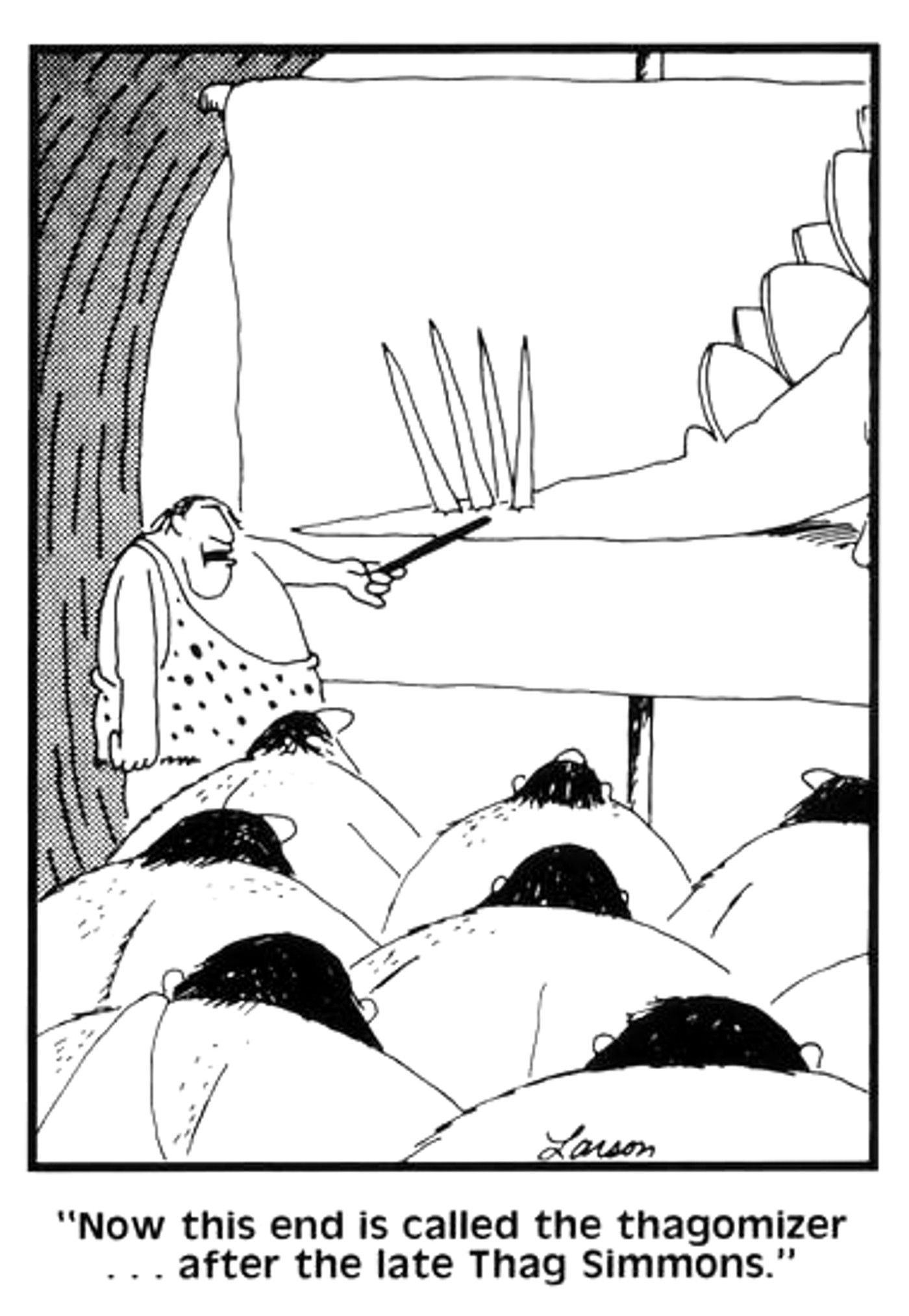
A comic depicting a group of cavemen attentively watching a presentation given by another caveman on the anatomy of the Stegosaurus. The caveman in the front points to an image of the Stegosaurus and says, "Now, this end is called the thagomizer... after the late Thag Simmons," indicating the spikes on the end of the tail.

As with most things I do research on, this one turned out to be more complicated than I thought it would.

Gary Larson is the cartoonist behind the very successful single panel comic The Far Side. The panel was syndicated in newspapers from 1980 to 1995, and some newer material appeared on the official website between 2020 and 2023. The humor is often described as "off the wall" and "surreal," though many times it can be incredibly relatable. Many of the jokes involve animals, and Larson was especially fond of using insects and prehistoric animals to tell his jokes. He also often used cavemen along with the prehistoric animals, which is of course historically inaccurate, but when the joke is funny enough it can be forgiven. That said, despite the historical inaccuracy, Larson has been praised by biologists for his attention to detail when it came to drawing the animals, especially the insects, and has gained a following among paleontologists from his many depictions of dinosaurs. In fact, he has amassed quite a following over the years in the scientific community at large, despite never being a part of it himself.

However, this is not to say that he was recognized by scientists immediately, or is enjoyed by all scientists equally, as will be shown.

Read more…

Comic Strip History - Mary Jane Shoes

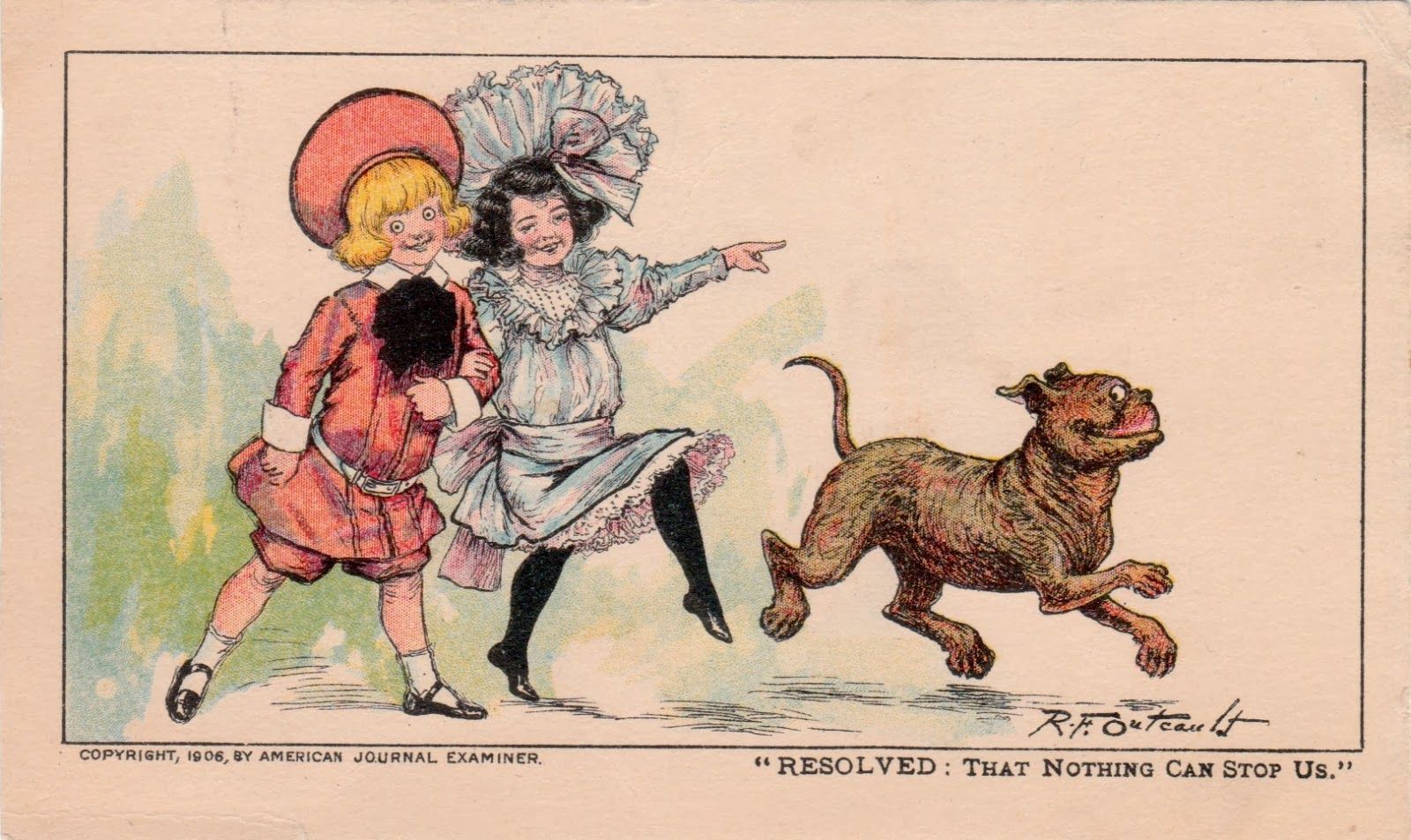
Buster Brown, Mary Jane, and Tige, from a postcard with artwork drawn by R. F. Outcault

Richard Felton Outcault is most notable for creating the first widely popular comic strip character, The Yellow Kid, for the New York World in 1895. Only slightly less notable is the fact that he also created the first widely licensed comic strip character, Buster Brown, for the New York Herald in 1902. Interestingly, the latter seems to have had a much larger effect on American culture than the former, due to the popularity of one particular license.

Read more…

Comic Strip History - Skippy Peanut Butter

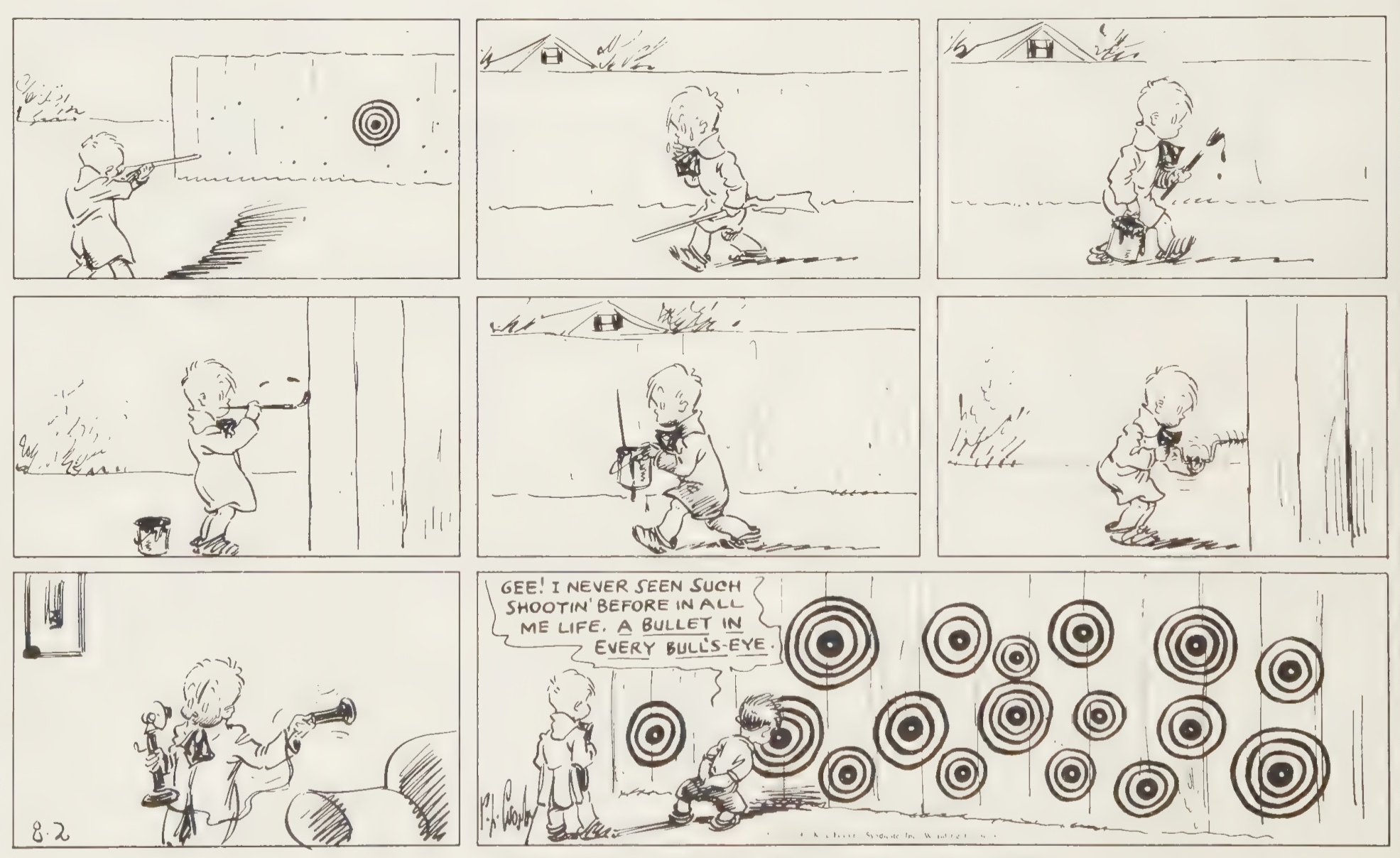
Skippy August 2nd

Up until now, when I've written about words or phrases that end up being popularized through comic strips, the stories behind them have been fairly simple. They generally haven't involved trademark infringement, FBI and IRS investigations, (alleged) staged suicide attempts, and (alleged) false imprisonment, but this one (allegedly) involves all of those, and more.

And all because of peanut butter.

Researching and writing about this has been an odd experience, partially because I've never really thought peanut butter could have such an effect on someone's life, but mostly because Percy Crosby's story is incredibly tragic. There are certain facts that are in dispute, but where he ended up and how it affected his family are not, and it's awful to think about. At times I found myself laughing due to the absurdity of all of this stemming from a peanut butter dispute, but I had to continually remind myself of the ultimate result, which is not at all funny.

Read more…

Comic Strip History - Milquetoast

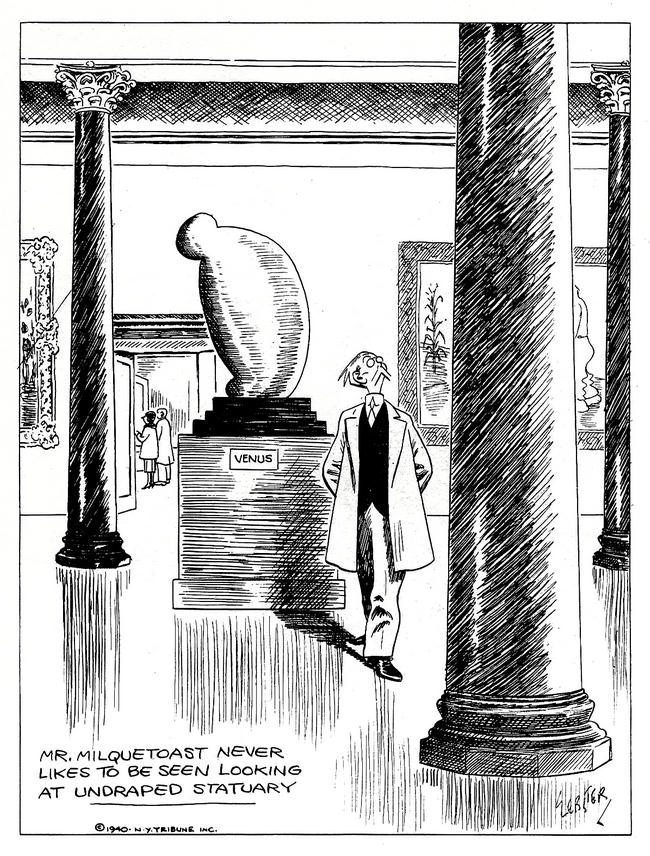
The Timid Soul, 1940

Milquetoast was a word that I first encountered in a comic strip, though not the one this blog post is focused on. In Berkeley Breathed's strip Bloom County, and its sequel strip Outland, there was a character named Milquetoast, who was apparently a cockroach, though he didn't look much like one. I remember being ignorant of how to pronounce his name, though I didn't really give it much thought as I figured it was just a weird name Breathed had come up with.

It was certainly a strange joke word created by a cartoonist, but not one coined by Breathed.

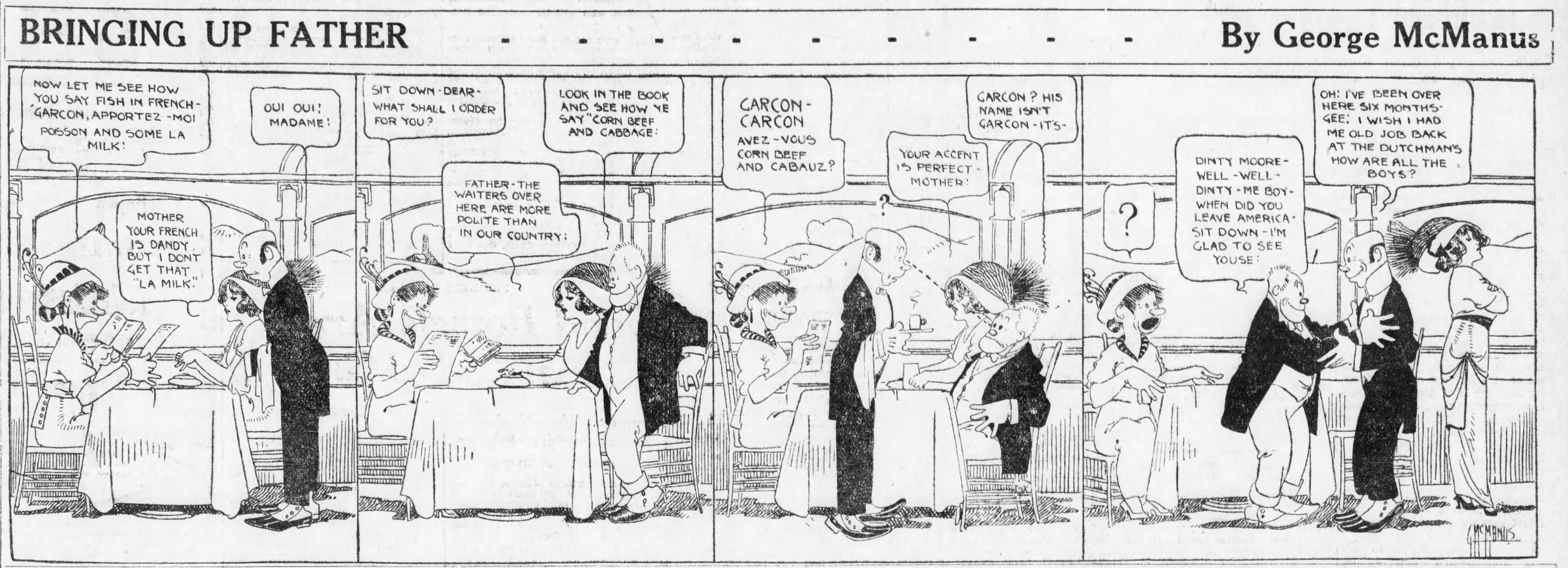
The word first appeared in 1924, in a comic strip called The Timid Soul by H.T. Webster. Webster had been doing single panel gag strips for the New York Tribune since 1912. His panels appeared under a number of different recurring titles, which would change depending on the subject matter of the gag, but none of them had any recurring characters. In 1924, he moved to the New York World, and while he did continue his other panels under their various other titles, he began a new one, The Timid Soul, and with it created a character by the name of Caspar Milquetoast. Caspar was, as the title of the strip suggests, the most meek and timid man you would ever meet, and his meekness would always land him in strange predicaments. Many of them involve him strictly following signs, such as when he decides to buy a new hat rather than retrieve one that has blown off his head and landed next to a "Keep Off The Grass" sign, or when he goes to the river for a dip and lights a cigar, but drops it when a discarded "No Smoking" sign floats by, or when he is completely immobilized by a "Watch This Space" sign. Many others involve him doing his best to avoid confrontations, whether it be not talking to someone about how he thinks the Dodgers are going to do this year, or not contradicting his neighbor when the neighbor holds him responsible for a hurricane blowing a tree onto his fence, or stopping by the side of the road to change his tie so he wouldn't have to tell his wife he hates the one she got him for Christmas.

Webster's The Timid Soul strips became his most popular, and Caspar Milquetoast literally became a household name. Comparisons of various people to Caspar in the wider media began quite early, but the reference was always to the comic strip character. Someone might be called "a Caspar Milquetoast," or "a Mr. Milquetoast," or even "a Milquetoast," but it was always a proper noun. Sometime around the early to mid-1930s it dropped the capital "M," and also began its life as an adjective, which is the form in which it's most likely to be found these days. In 1988 Berkeley Breathed created a cockroach character with that name, which I now realize was meant to be ironic.

The word itself is confusing to many people due to their ignorance of its origins. Part of it looks vaguely French, so one might assume it came from French or Latin somehow, though that wouldn't explain the "toast" at the end, which is very English looking. It wouldn't occur to most people that a funny looking word with no discernible linguistic origin may have been invented for a comic strip. The word does have a clear etymology outside of just being a comic strip character's name, however: Webster was obviously referencing "milk toast," a dish reserved for those with weak stomachs, and possibly thinking of the term "milksop," which references a similar dish, and has been used for a few centuries to refer to weak, timid men. In fact, it's possible he may have gotten the two dishes confused when concocting his comic character, though that's just speculation on my part.

For more information:

Hairy Green Eyeball has a nice collection of The Timid Soul strips

WordOrigins.org for more on the origin of the word

Atlas Obscura for more on the character and its creator

Neglected Books for more on H.T. Webster

Comic Strip History - The Worry Wart

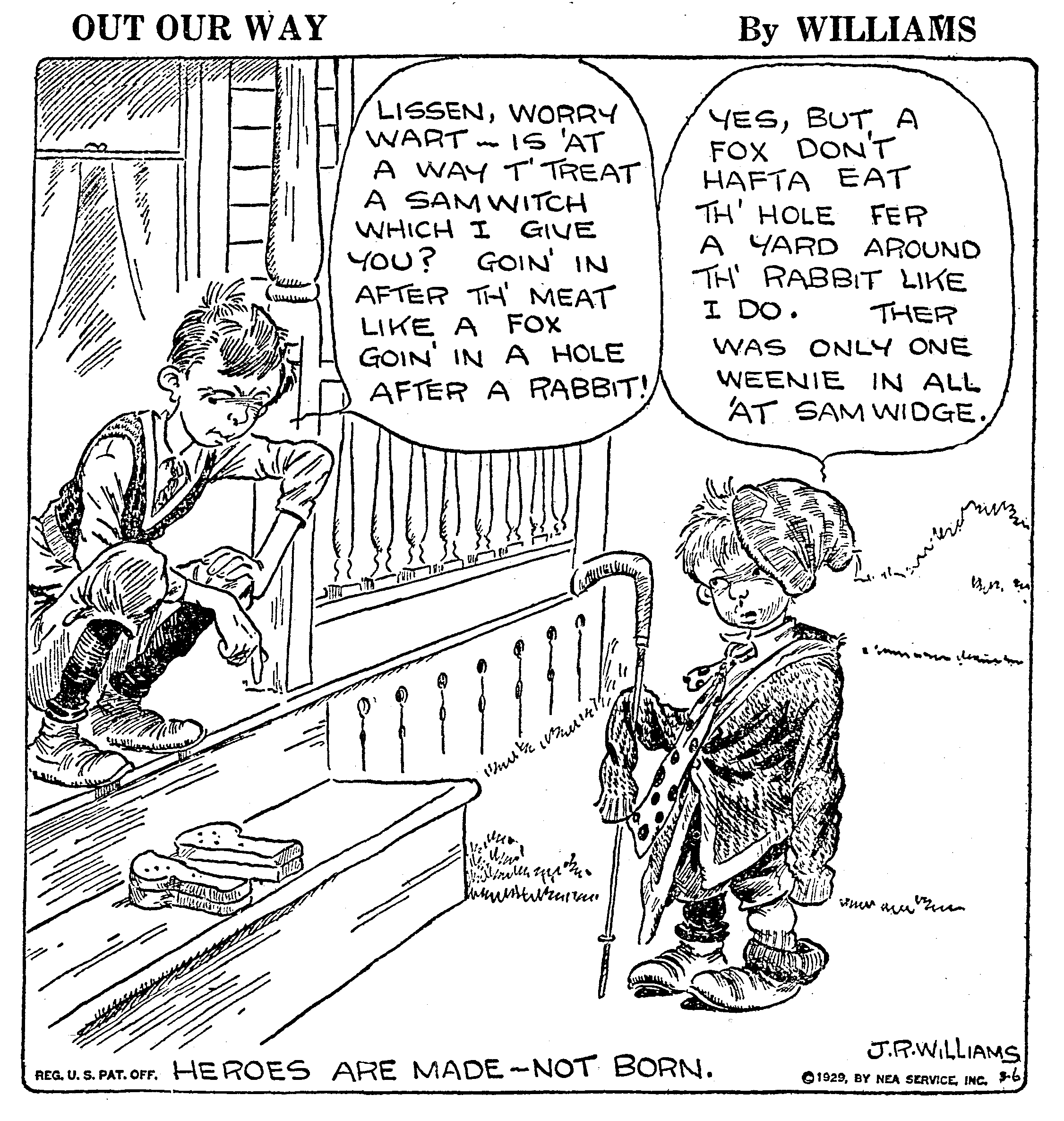
The Worry Wart, March 6, 1929

Most times I've done research for posts about words that originated in comic strips, I've been able to find fairly consistent information about where and when they first appeared. The information I was able to find may not have been very plentiful, but at least it told a consistent story. Not so with "worry wart." It seems pretty clear that the phrase originated in a comic strip, but no one seems to agree on when. I think I've found the correct answer, though.

What all the sources I found do agree on is that there was a character called "The Worry Wart" in the comic strip Out Our Way, created by J.R. Williams. Out Our Way was what you might call a nostalgia comic. It centered around people who appear to live in the late 19th century in rural surroundings. Most of the characters are unnamed, though many of them reappear from time to time. The jokes generally revolve around relatable situations that the reader would probably remember from their childhood, or possibly remember hearing about from their grandparents when they were young adults in the old days. The strip started in 1922 and had a fairly long run, ending in 1957.

All those sources also agree that the way the term was used in the strip wasn't exactly the same way we usually think of it. Normally when we use the phrase, we mean someone who worries incessantly, possibly to the point of growing warts. In the comic strip, The Worry Wart was a small boy who, due to his actions, caused endless amounts of worry to his family, and especially his mother. While the meaning wasn't the same, it's still fair to say that the comic strip is the origin of the phrase, as the term had never been used to refer to a person before, if it had ever been used at all. Etymologists are free to quibble, but it seems pretty clear cut to me.

The issue of when the term first appeared seems to be a bit thornier, and there is a lot of misinformation about it on the Internet, even from otherwise reputable sources. Now, if we all agree that the origin of the phrase is the comic strip, then it stands to reason that all we would need to do is find which strip the term first appeared in, and we have our answer. This does pose a problem for some, however, as they may not have access to an archive of the strip, and they may not feel inclined to look through every single one to find it. After all, it was a daily comic strip that ran for 35 years. That's a lot of strips. This means that most places you look are most likely relying on information from other sources that they trust to have the right information. Unfortunately, most of them do not.

Many places put the first appearance of the phrase in 1956, most likely owing to the fact that this is what the Oxford English Dictionary says. This is odd, given that Out Our Way only ended a year after that and had been running for quite a while by that point. One would think that they must be using a different source for the origin of the phrase, but they don't. They still credit Out Our Way, and some places even call it "a 50's comic strip" (which is also odd, as by that point its popularity was waning). The mistake seems to come from someone confusing the publication date of the comic strip with the publication date of a reprint comic book. Dell Comics did publish a reprint comic in 1956 called "Out Our Way With The Worry Wart," which was part of a series of comic books that reprinted various newspaper strips. I could only find one Out Our Way issue, and I doubt a popular phrase would have spawned from a single issue of a comic book. Incidentally, there is another comic book with a character by that name who appeared over a decade earlier. All-Flash, issue 15, from 1944, included a character named Ebenezer Jones. Jones suffered from crippling anxiety, which was discovered to be caused by some kind of virus. An evil scientist decided to make it contagious in order to infect others with the anxiety (that's Golden Age superhero comics for you), earning Jones the nickname "Worry Wart." Even if Out Our Way wasn't the origin of the phrase, that issue of All-Flash confirms that the term was in use long before 1956.

Other places I searched are much more reasonable. Most of them are fairly vague, stating that the term first appeared sometime in the 1930s. Merriam-Webster is more specific, putting the first appearance in 1936, though it does contain the caveat that this was the first time it was used as it's currently defined in said dictionary, not necessarily how it was used when the term first appeared. That's fair, though as I said, it's unlikely that it would be used at all if it hadn't been popularized as a phrase earlier than that.

Finally, we have sources that appear to actually correctly date the first appearance of the phrase, which I will link below. I know that these are correct, because although others may not have enough patience or access to resources to find this out, I certainly do. I searched through every Out Our Way strip, beginning in 1936, and worked backward. The earliest one I could find is from March 6, 1929 (pictured above). There are strips from earlier years that feature a similar character, but he's never called The Worry Wart in those strips. To be honest, because of that fact, I stopped searching in around the middle of 1927. It's possible that the term was used earlier, but unlikely.

For more (good) information take a look here:

Columbia Journalism Review

World Wide Words