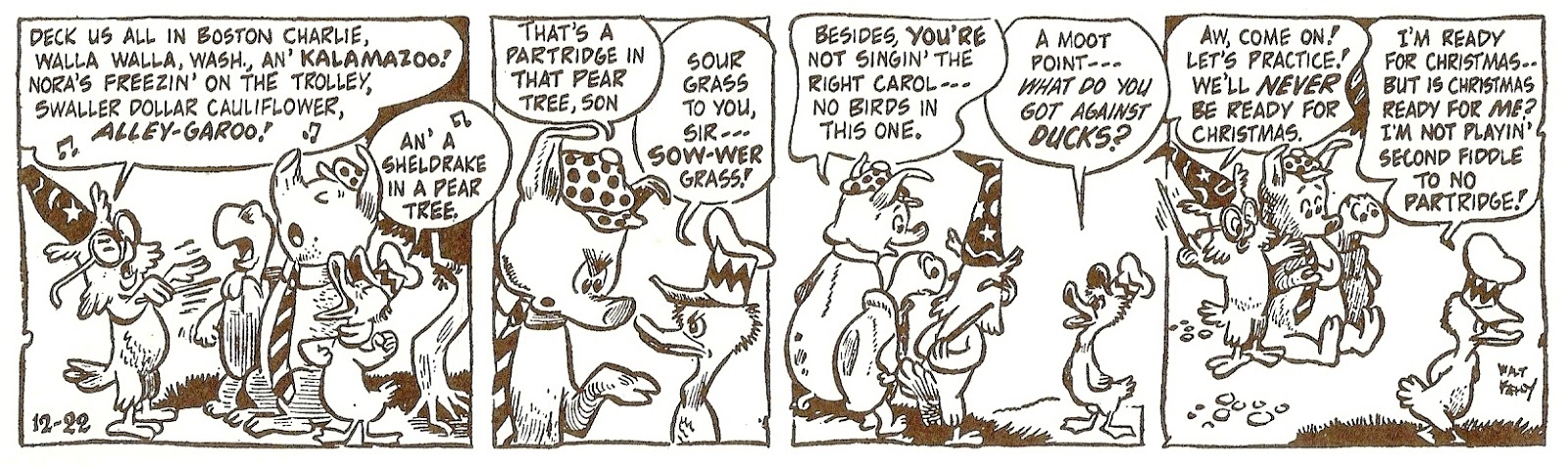
Pogo, December 22, 1950

Pogo 12.22.1950

Click the image to see a larger version.

Walt Kelly was well known for making his own versions of well-known Christmas Carols. "Deck Us All In Boston Charlie" was probably his most popular, and is featured in this strip. Of course, there were other strips which gave us the "Twelve Days of Crispness," which included a parsnip in a pear tree, as well as the lively "Good King Sauerkraut." "Boston Charlie" actually has six verses, which you can read by clicking here. Learn them and sing them at your Christmas party. I dare you.

Pogo, December 27, 1958

Pogo 12.27.58

Click the image to see a larger version.

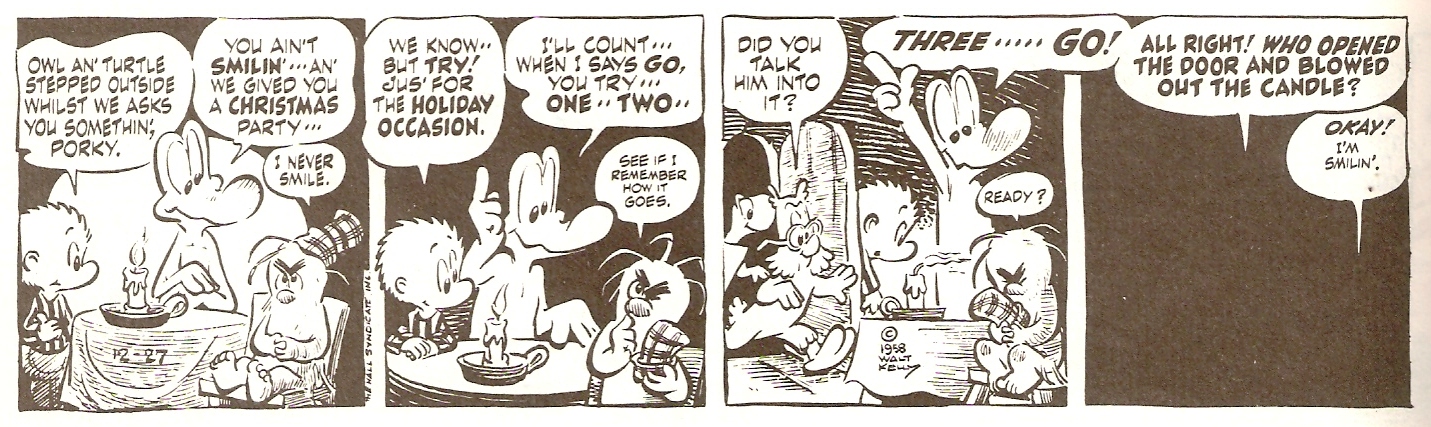
Going back to the idea of even the greatest cartoonists reusing their old jokes, here we see a Pogo strip similar to the one I posted yesterday. It has been reworked a bit, and some dialogue has been added (I like the addition of "See if I remember how it goes"), but in essence it's the same strip. Still, it's a good one.

Pogo, December 26, 1949

Pogo 12.26.1949

Click the image to see a larger version.

Again we see Porky Pine, the perpetually grumpy, promising to smile for Pogo and Albert. It apparently takes some preparation and thought, as it isn't something Porky does very often. Unfortunately, no one gets to see it, and Walt Kelly only has to draw three panels (I tell you, the darkened room is the best way for cartoonists to save time and effort without looking lazy). While this is the case, I think it does show that while Porky normally is grumpy, he at least is generous enough at Christmastime to try to give us a gift like that.

Pogo, December 22-24, 1949

Pogo 12.22.1949

Click the image to see a larger version.

I also highly appreciate Walt Kelly's Pogo. As someone who prefers to draw cartoon animals to cartoon people, I think Pogo is the best example of a large, diverse cast of fun animal characters. While there are some well-known politically satirical episodes in Pogo, during Christmastime Kelly tended to stay light and silly. He often would come up with new versions of Christmas carols, such as the one featured in the first strip here, "Deck Us All With Boston Charlie, Walla Walla Wash and Kalamazoo."

In these three strips, we see Porky Pine, a sad porcupine orphan, being shown the true spirit of Christmas by being included in the festivities even though he thought he wasn't. Warms my heart.

Krazy Kat, December 15, 1918

Krazy Kat 12.15.1918

Click the image to see a larger version.

Again, I love Krazy Kat, mainly because of strips such as this, with the slightly overwrought narration, Krazy's dialect, and the ridiculous idea Krazy has that Ignatz Mouse throwing a brick at him is a sign of affection.

I also enjoy the implication that people who don't believe in Santa are heretical sinners, and therefore are evil, selfish brick-throwers.

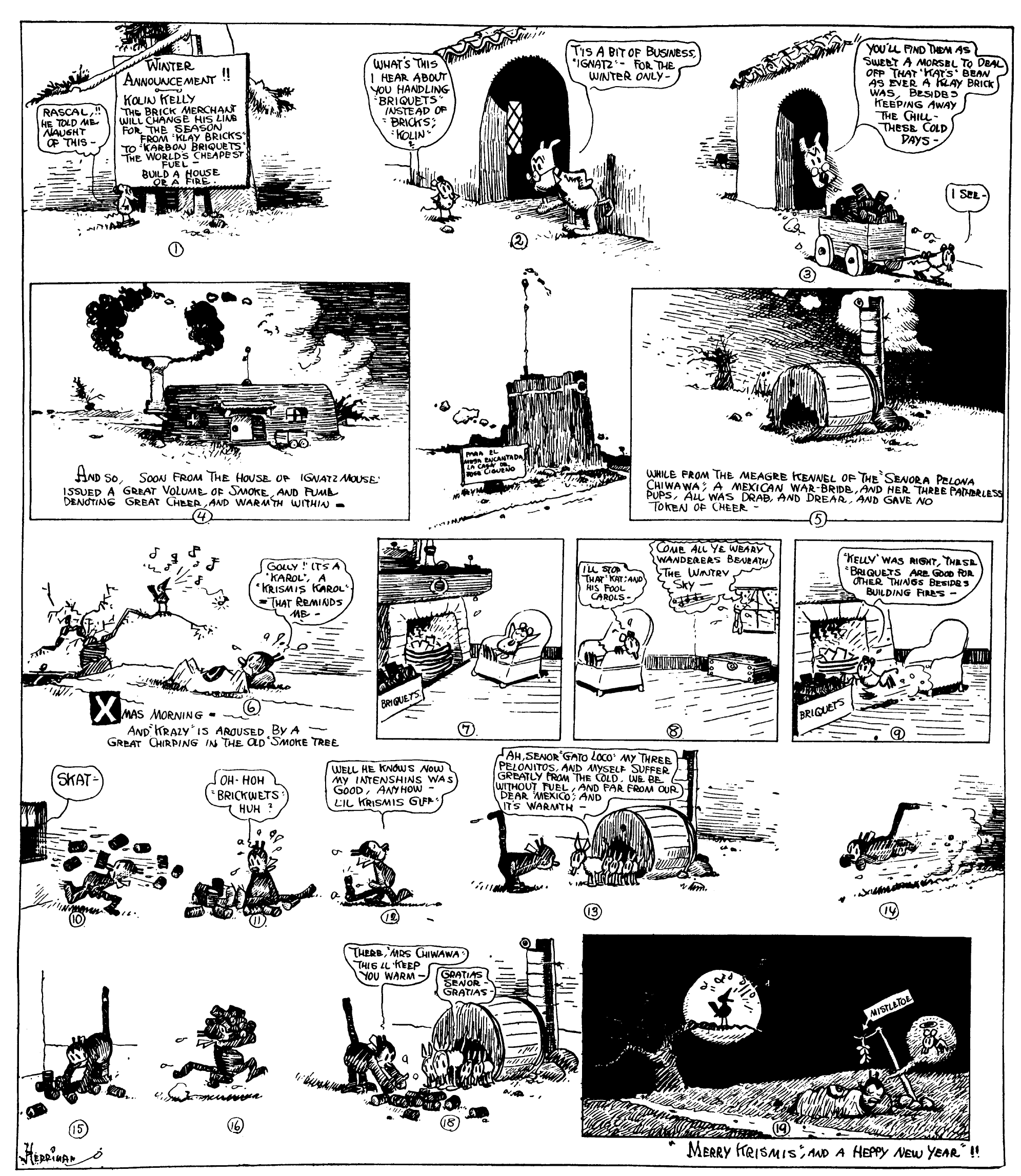
Krazy Kat, December 24, 1916

Krazy Kat 12.24.1916

Click the image to see a larger version.

While I love Winsor McCay and all he did, another one of my favorite early 20th century cartoonists is George Herriman, who most famously drew the strip Krazy Kat. He didn't do too much in the way of Christmas comics, but he did a couple. This one shows how generous Krazy Kat is to a dog family. He gives them some "brickwets" to make a fire and keep them warm, even though he has to sleep outside in the winter cold as well.

Krazy Kat has long been one of my favorites, because of the fun drawings, the clever dialogue, the interesting dialect that always comes out of Krazy's mouth, and the incomprehensible love triangle between Krazy, Ignatz, and Officer Pup.

Dream of the Rarebit Fiend, December 20, 1904

DreamoftheRarebitFiend 12.20.1904

Click the image to see a larger version.

Dream of the Rarebit Fiend was another comic strip that Winsor McCay drew prior to Little Nemo. There is a long tradition of cartoonists reusing ideas, and here is an early example of that. You may notice that this one bears a striking resemblance to the Little Nemo strip from December 13, 1908. Of course, instead of Nemo hanging from the roof and freezing, it was originally Santa Claus (or at least John dreaming that he is Santa Claus).

In the Land of Wonderful Dreams, December 17, 1911

LittleNemo 12.17.1911

Click the image to see a larger version.

In June of 1911, when it moved from the New York Herald to the New York American, Little Nemo's strip was renamed "In the Land of Wonderful Dreams," but it still had the same basic premise. Doctor Pill here gives Flip a magical chair, which appears to wrap its arms around whoever sits in it and run around. Many of Nemo's dreams seem to involve living furniture. I wonder why.

Little Nemo in Slumberland, December 18, 1910

LittleNemo 12.18.1910

Click the image to see a larger version.

This is continuing a story where Nemo, Flip, and the Owl are flying various places (including a jail) in their own blimp. This year, Santa apparently has a sleigh-plane, and no reindeer. In Nemo's dreams, Santa has many vehicles, and isn't too good at his job, because he is often losing toys. I would think Nemo would have a higher opinion of him. Thankfully, Nemo and friends help him out, kind of. I mean, wouldn't the toys get all dirty and sooty?

Little Nemo in Slumberland, December 19, 1909

Little Nemo 12.19.1909

Click the image to see a larger version.

Here we see the remains of Santa's crashed airship. But apparently he has yet another mode of travel, an airplane of some kind. Of course, King Morpheus has the largest Christmas tree imaginable.

Also, I continue to be amazed by McCay's architecture drawings. I think they're the best part of any of his strips.