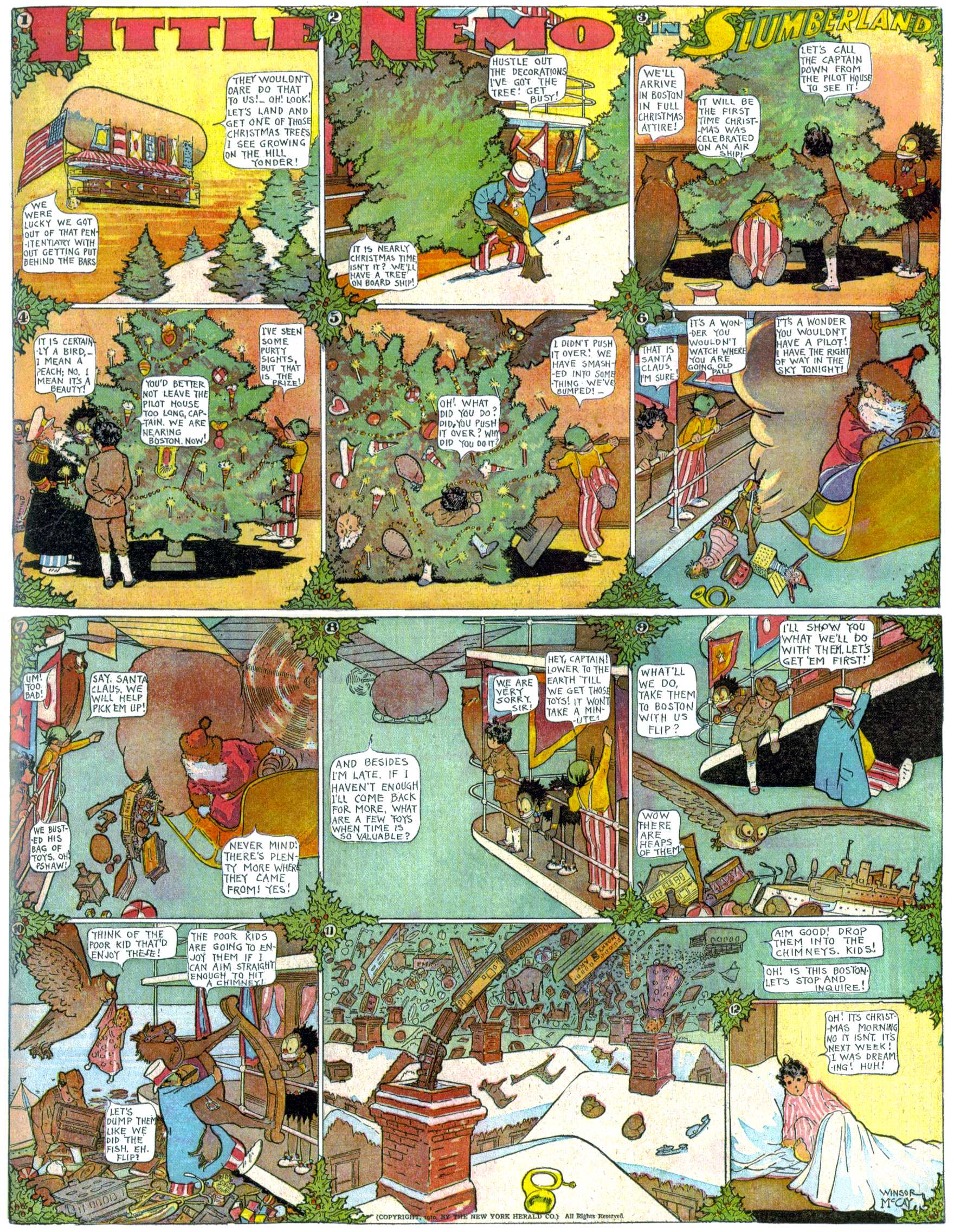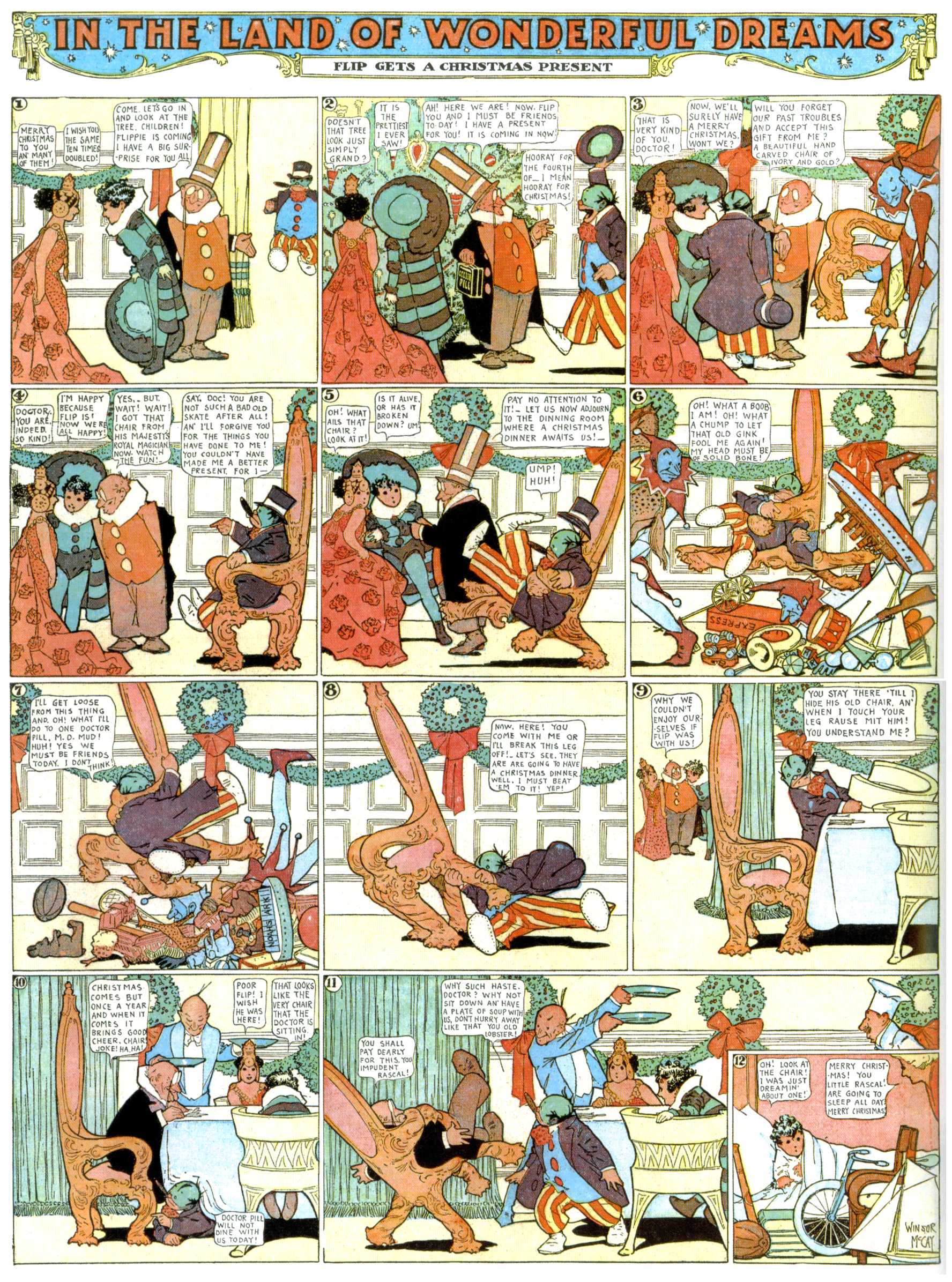
Little Nemo in Slumberland, December 12, 1909

Little Nemo 12.12.1909

Click the image to see a larger version.

Santa has not yet learned to just stick with the reindeer and the sleigh. He now has another airship, which looks different from the one he had in the last strip. I really like that penultimate panel with the falling toys, though.

And... the princess of Slumberland is asking Santa for Nemo for Christmas?

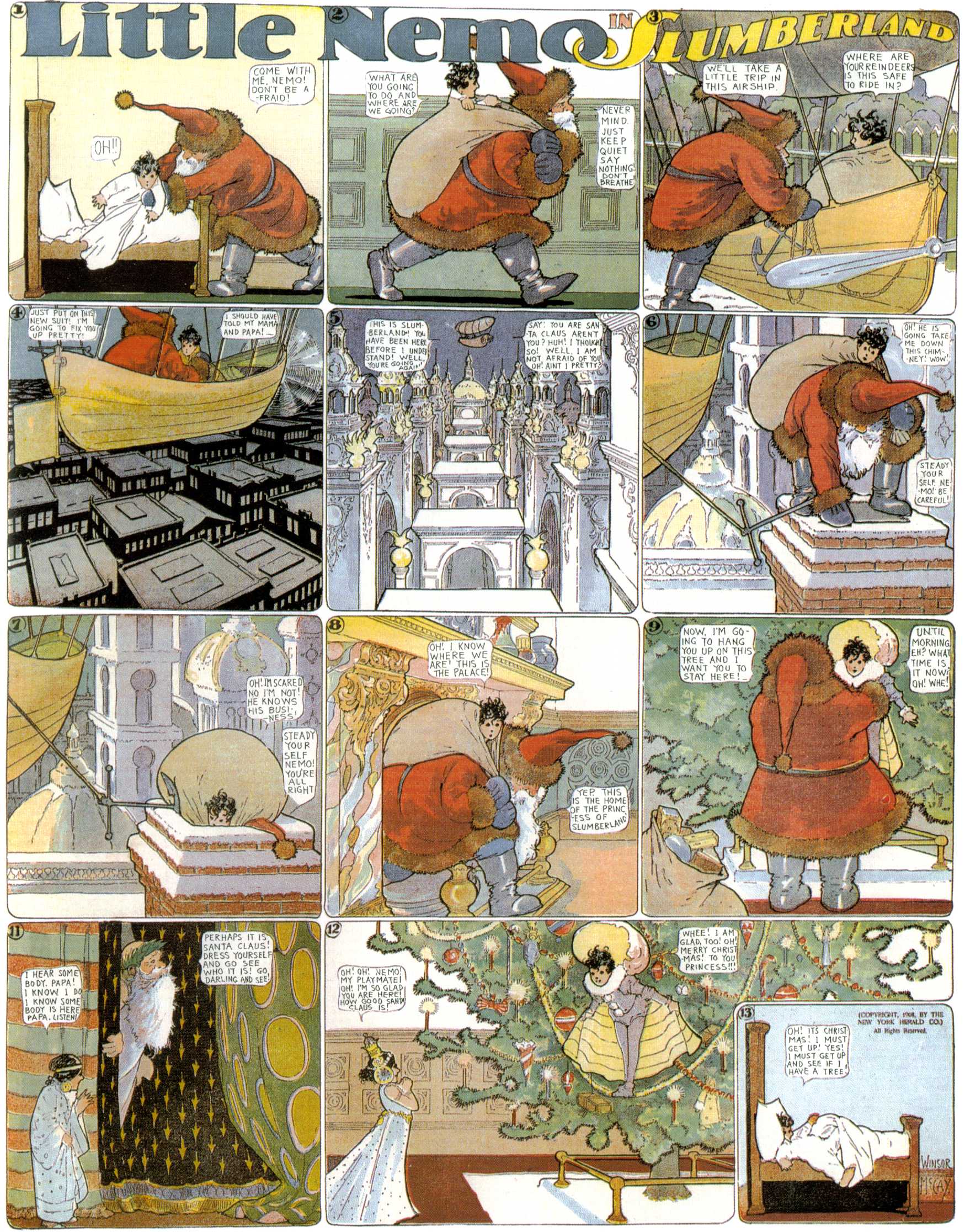
Little Nemo in Slumberland, December 20, 1908

Little Nemo 12.20.1908

Click image to see a larger version.

Santa has ditched his reindeer once again for an airship. Also, he apparently never uses the door, but always the chimney. I do wonder, though, why it is that King Morpheus and Santa Claus look so similar, and therefore if they're related somehow.

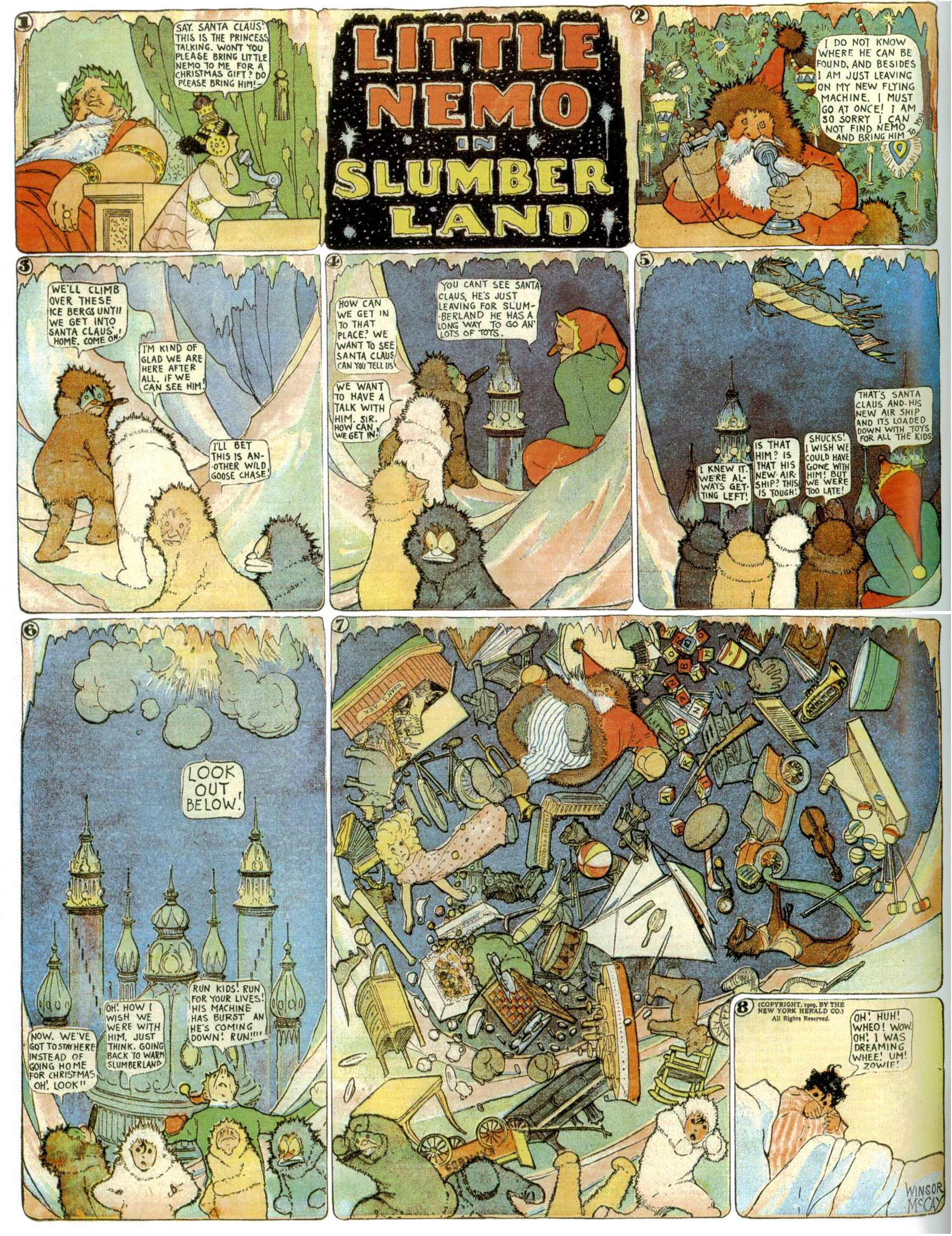
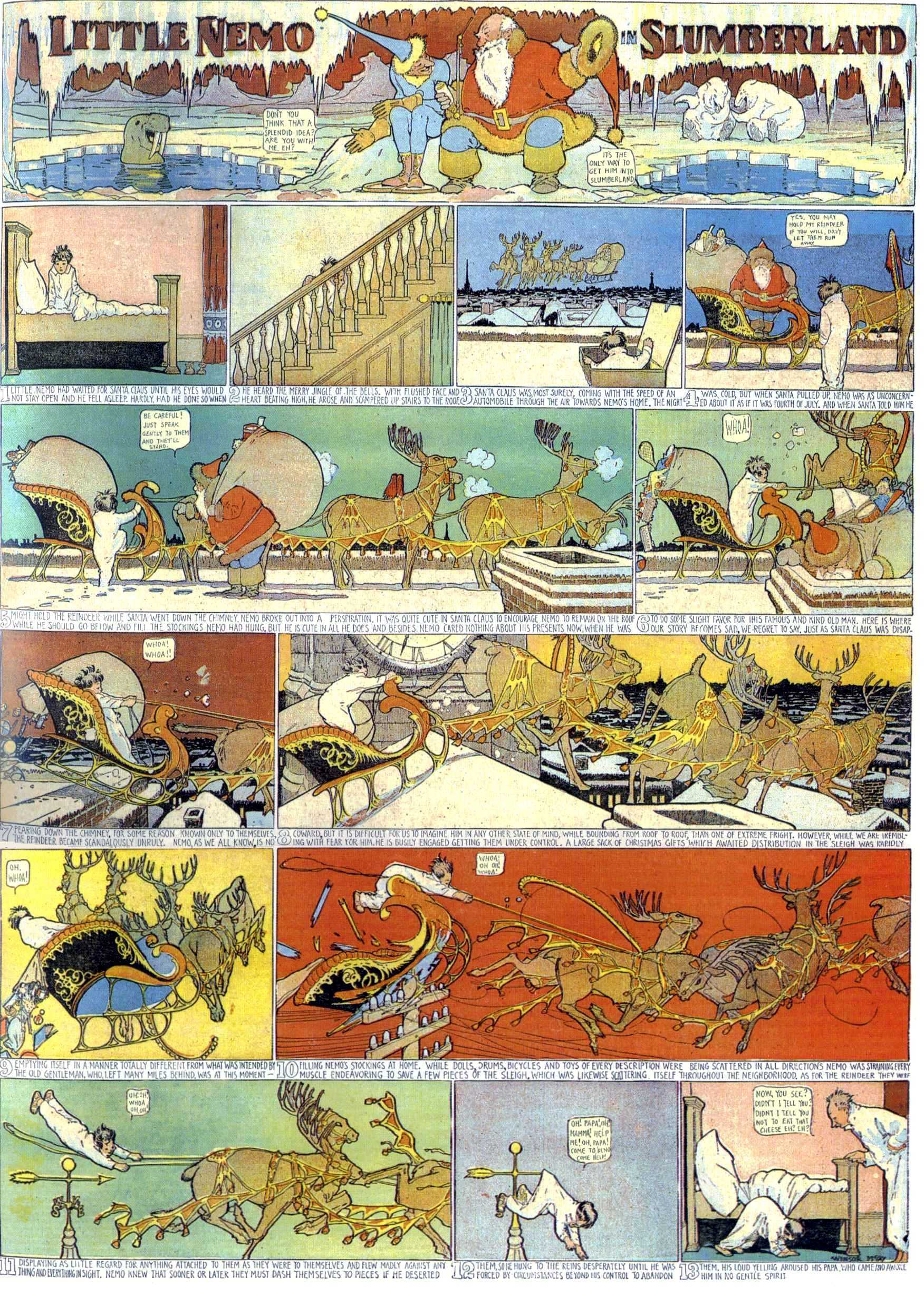
Little Nemo in Slumberland, December 13, 1908

Little Nemo 12.13.1908

Click the image to see a larger version.

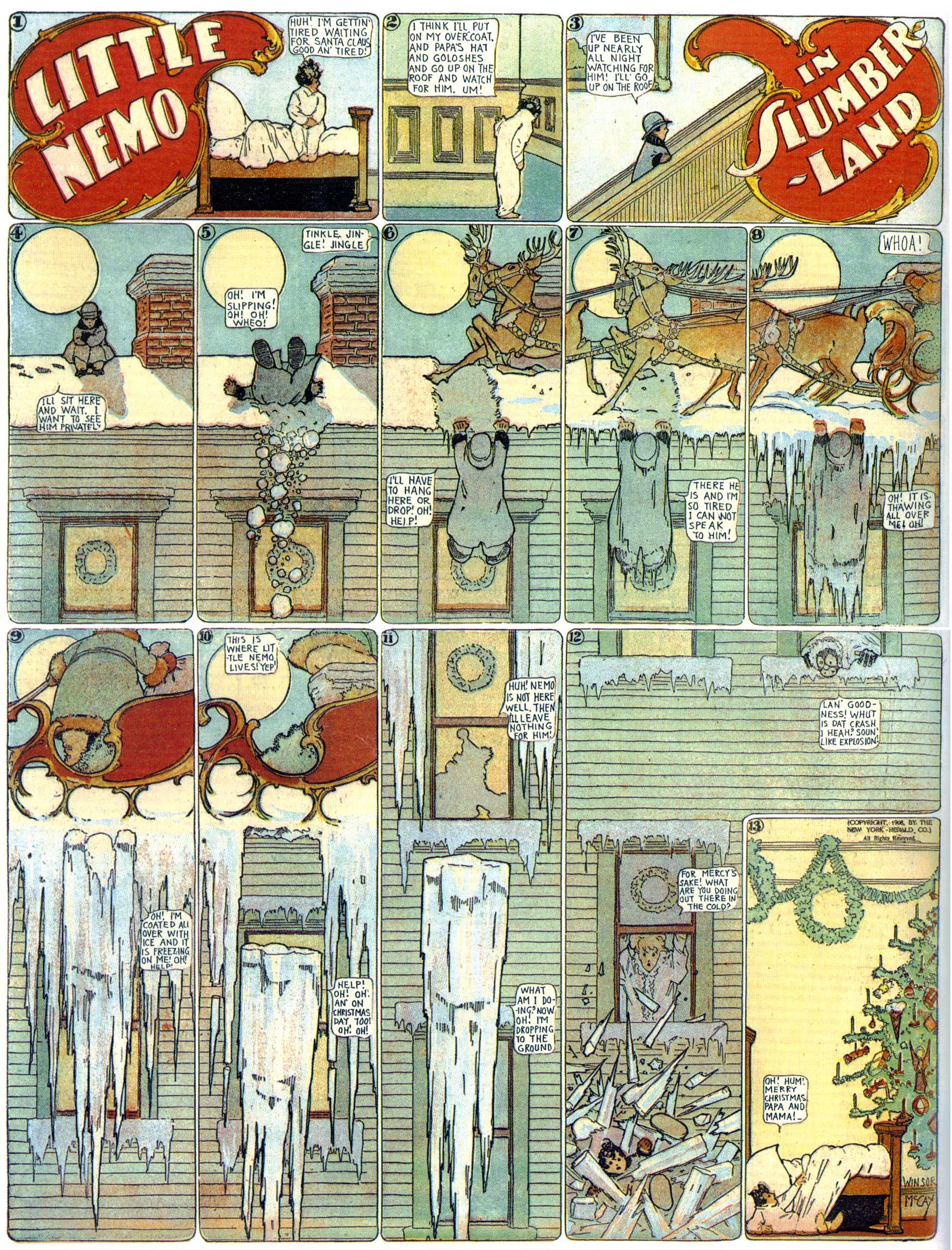
Nemo's dream (or nightmare, really) demonstrates why children should go to sleep instead of staying up to see Santa Claus: One, because you'll become covered in frozen icicles, and two, because apparently even if he knows you live there, if he doesn't see you he won't leave you any gifts.

Please disregard the turn of the century racist stereotype in the penultimate panel. I love Winsor McCay, but he was a product of his time.

Little Nemo in Slumberland, December 22, 1907

Little Nemo 12.22.1907

Click the image for a larger version.

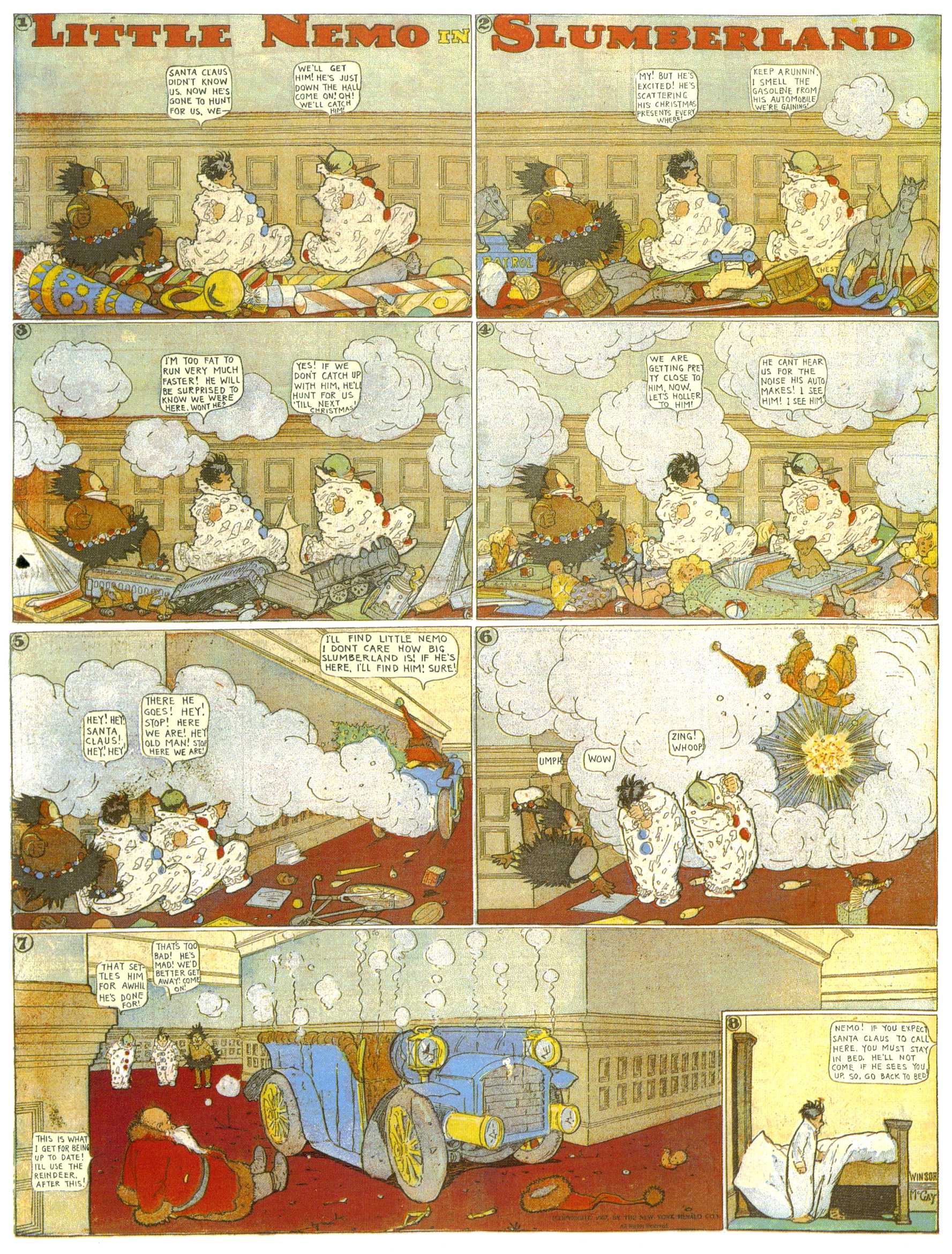
Now we find out what happens when you drive your car-sleigh inside your house. Of course, it crashes and you get blown out of it. Santa wants to go back to the reindeer after this, but will he drive the sleigh in the house with them?? I hope not.

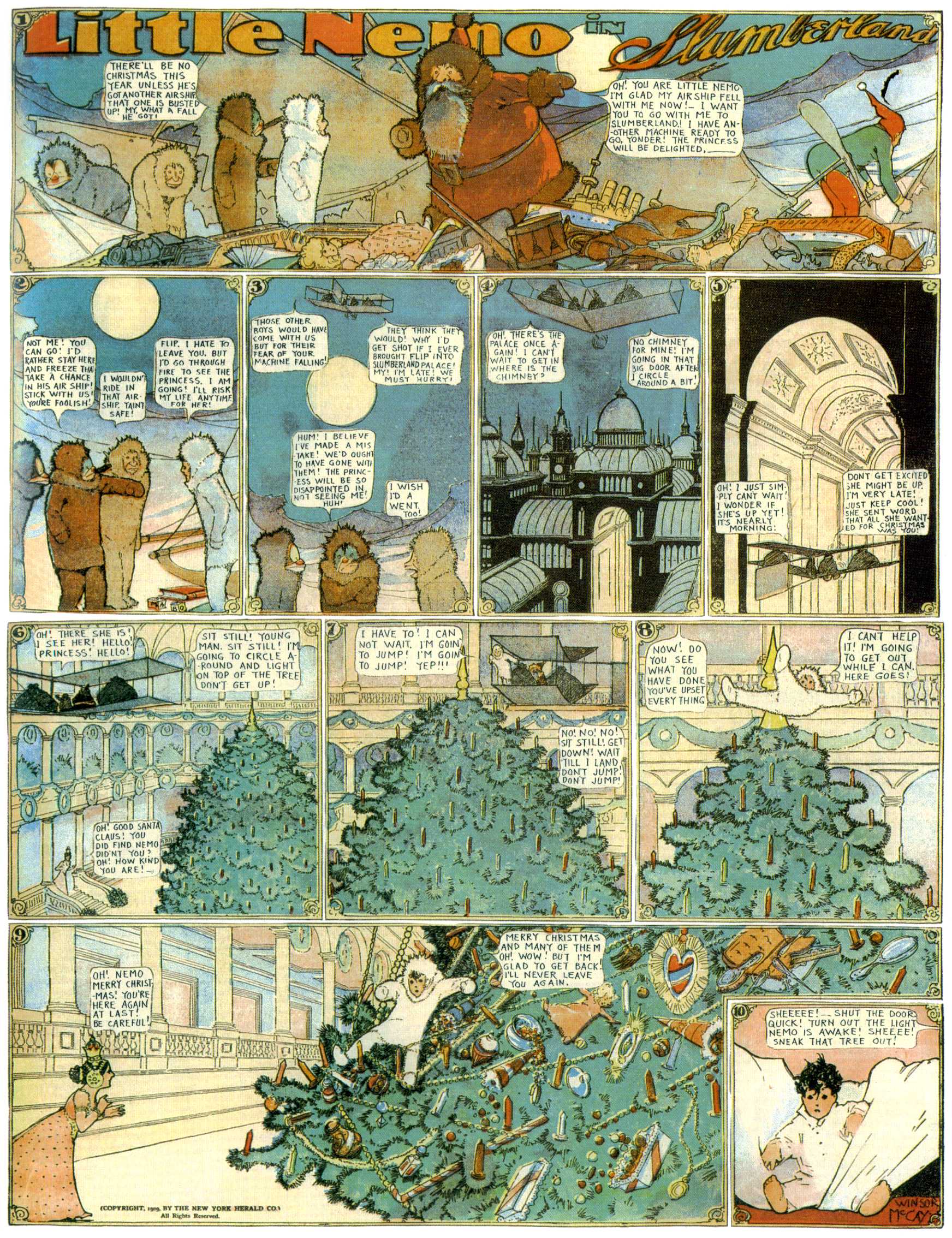
Little Nemo in Slumberland, December 15, 1907

Little Nemo 12.15.1907

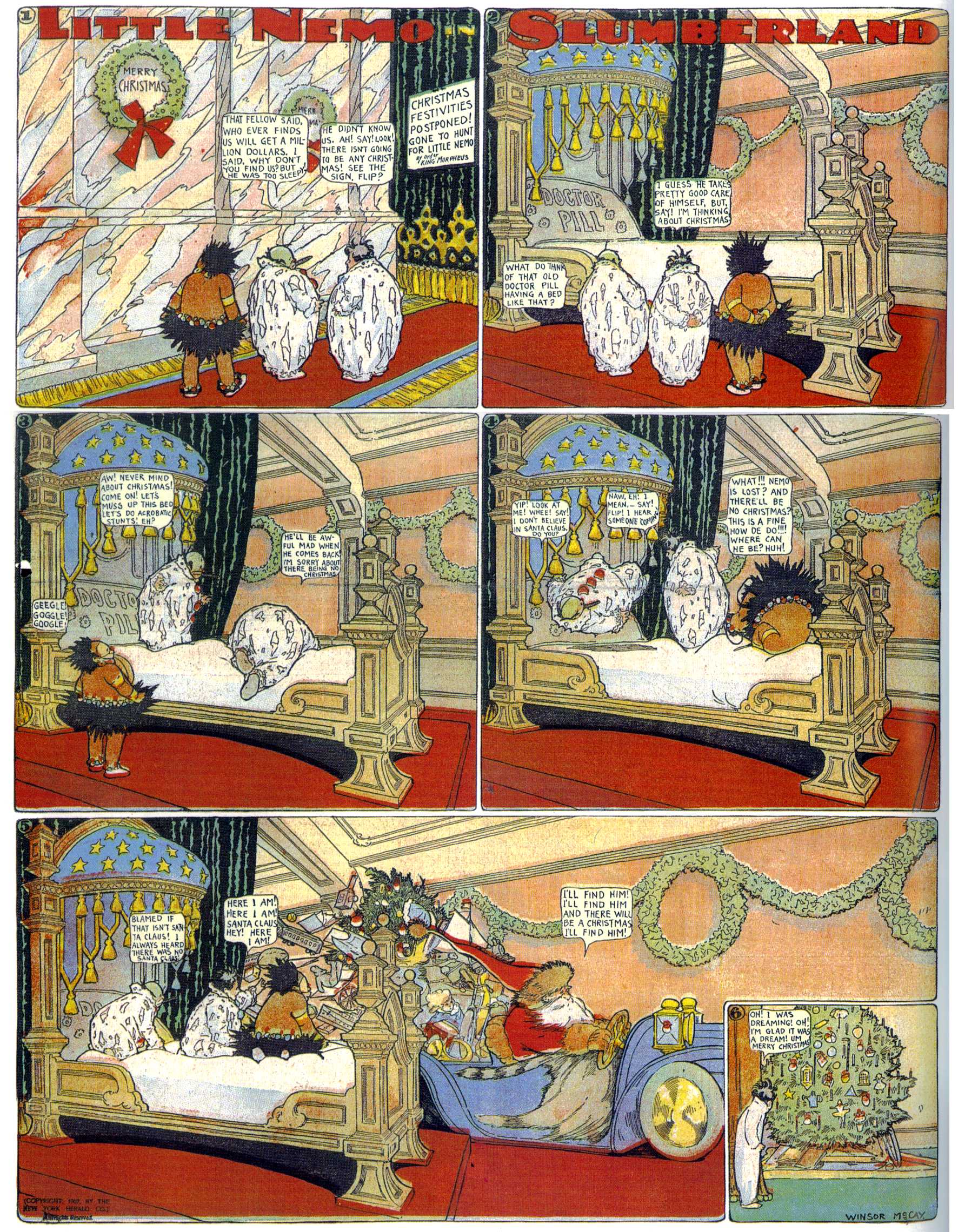
There'll be no Christmas if they don't find Nemo? Don't worry, Santa's on the job!

There is an ongoing story here involving Nemo being lost and King Morpheus trying to find him, though I guess the king doesn't care much about Flip or the imp. I love Santa's awesome car-sleigh.

Little Nemo in Slumberland, December 23, 1906

Little Nemo 12.23.1906

Click the image to see a larger version.

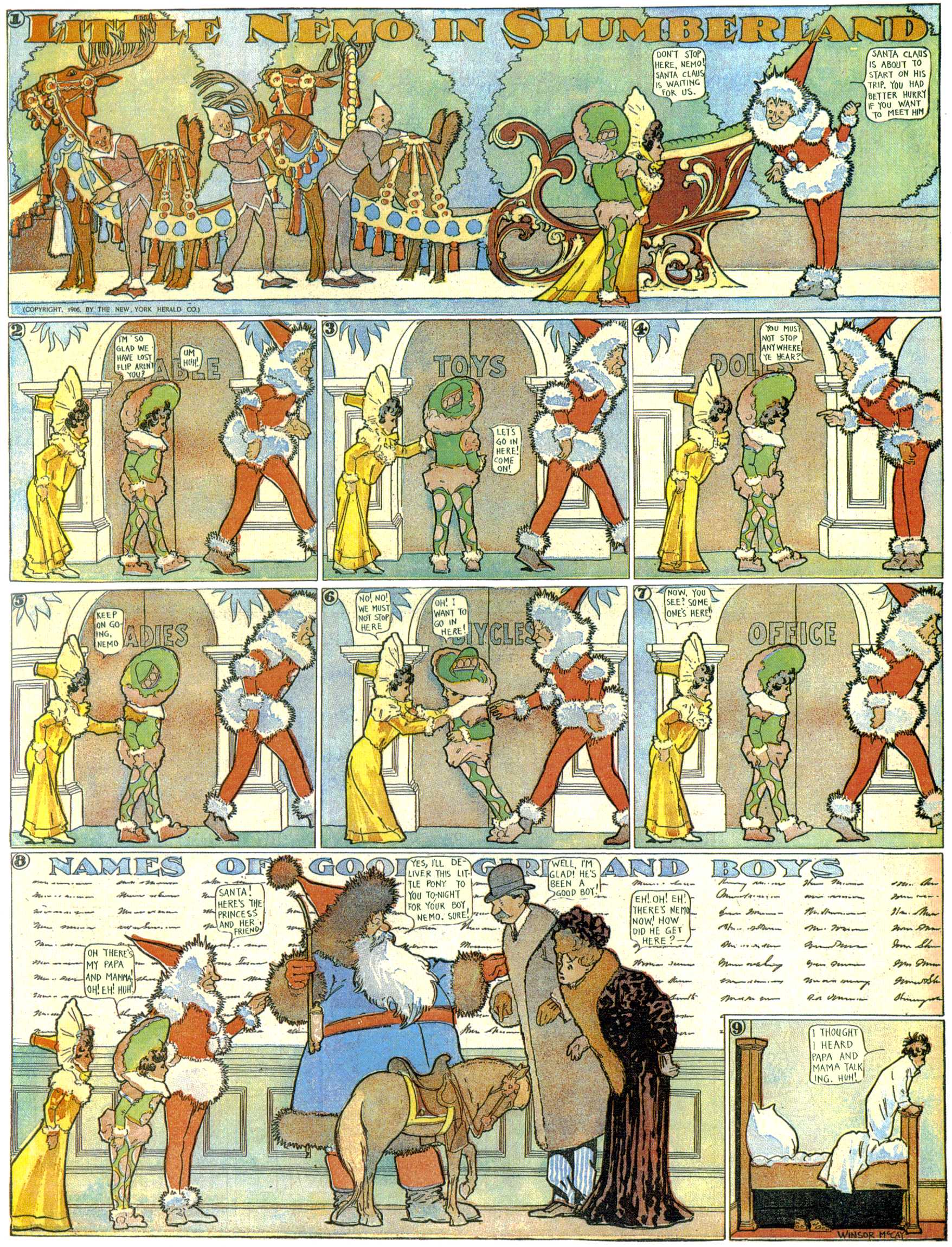
It's interesting to note that McCay's Santa Claus is not colored consistently. He wears red, blue, and green in different strips. These days, we wouldn't dream of having Santa wear anything but red and white, but it wasn't always so. McCay was probably just following the trend. His hat, and the hats of his elves, are also far pointier, and not as floppy.

I like the fact that Nemo glances at the Ladies' room and the lady tells him to keep moving.

Also... what is that outfit Nemo is wearing...??

Little Nemo in Slumberland, December 24, 1905

Little Nemo 12.24.1905

Click the image to see a larger version.

I imagine it would be exciting for a little kid to get to drive Santa's sleigh, but at the same time I think it would turn out just as well as it does here. I don't know if every kid would get caught on a windvane, but the sleigh would certainly be lost. Nemo lost the second bag of toys, too! Good thing it was only a dream.

Little Nemo in Slumberland, December 17, 1905

Little Nemo 12.17.1905

Click the image to see a larger version.

Looking at Winsor McCay's work, and especially Little Nemo, has always impressed me. It's amazing to think that this appeared in a newspaper. Look at where Santa Claus lives! I guess he would need a place that big to house all of the toys for all the children in the world.

The lettering is difficult to read, but you hardly need to. It's nice enough just to look at.

December 2014 - 31 Days of Comic Strips

I haven't updated this blog in quite some time, and when I did it was to whine about Facebook and a single musing about my art. My end of year resolution, as it were, is to do more to share things that I'm passionate about. If there is a single thing that I could pick that I've been passionate about for the longest time, it would be comic strips. Since it's December, and I happen to celebrate Christmas, I figured it would be appropriate to post some Christmas (and New Year) comic strips from cartoonists that I admire and have influenced me, namely Winsor McCay, George Herriman, Walt Kelly, Charles Schulz, Bill Watterson, and Richard Thompson. I hope they are interesting to you, even if you don't happen to celebrate Christmas.

Why messy is good

There is no shortage these days of illustrations and designs that are clean, smooth, and flat. Vector drawings are popular because people like this look. It works well on websites and in apps. I can't deny that it looks very nice, and it's what I've come to expect in app and web design.

That said, I don't do that. At least, I don't do it often. I like to make things a little more messy. One reason for this is that I'm not very skilled in vector drawing. The main reason, however, is that I want to make it look like an actual person made it. I don't want it to look like it could have been made by a machine. I like any art with a discernible human touch.

In college, in drawing class, it seemed that everyone, including the professor, was obsessed with clean edges. The edge of the drawing had to be taped so that it was straight, and there couldn't be anything in the margins. Besides the fact that I didn't want to deal with the annoyance of measuring and taping and wanted to just draw something, I like fuzzy edges. It's fine to have a clearly defined margin and a clear edge of the artwork, but it doesn't have to be entirely straight. It can be fuzzy. Yes, fingerprints in the margins are normally frowned upon, but it wouldn't kill you to have a little bit of graphite or charcoal or ink in your margin. If you think your piece is that important, you're probably going to frame it anyway, so no one will even see it. Let it be a little messy. People will know that someone, a human, made it.

This is one reason why I have an aversion to photorealistic paintings. We have cameras. They can capture an image almost exactly the way it would look in real life. Therefore, while I respect the skill that photorealistic painters have and the time they put into their pieces, I don't see the point of them. While I do like a painting to have a discernible subject, I want it to be a little messy. I want things to be a little distorted, a little abstracted. Let me know that it's something you made, and that a machine couldn't have done. Infuse it with your humanity.

The point is, we have machines that do all kinds of things for us, and eventually they'll be doing art for us, too. If you, a human, are going to create an artwork, let me know you did it. Don't think that just signing your name will tell me that. Give the work your human signature. Embrace messiness.