Popeye the Sailor has had an immense influence on both American culture and world culture, and it would be easy for me to write an entire blog series focused solely all the ways he has done so (just take a look at the list on Wikipedia). I don't plan to write about all of those things, of course, but there are some stand outs that I would like to tackle. I thought it would be best to start with the one thing that everyone who knows anything about Popeye knows that he loves to eat: spinach.
It's a well-known fact that when Popeye is in need of a little extra boost to get himself out of a bind, he downs an entire can of spinach, after which he gains superhuman strength. This is how it always goes in the Popeye animated cartoons at least. The theme song even calls attention to this fact, when Popeye sings "I'm strong to the finich cause I eats me spinach." It's quite odd as far as famous elixirs of health go, but it fits with the silliness of the slapstick comedy on display in the cartoons, and also makes some kind of real world sense when you consider it. Leafy greens are known to be healthy in general, and most people are aware that spinach has important nutrients such as iron in it, so it stands to reason that it could be something a strong man would eat to get even stronger.
But it wasn't always this way. Popeye's relationship with spinach has changed over the years.
Popeye first appeared in a newspaper comic created by E.C. Segar titled Thimble Theatre. The strip began in 1919, though Popeye would not appear until ten years into its run, in 1929. He was an immediate sensation, and soon became the star of the strip. The title of the strip was even changed to Thimble Theatre Starring Popeye, and eventually to simply Popeye. In 1933, he began appearing in a long running series of cartoon shorts from Fleisher Studios, which increased his popularity and notoriety even further.
It was the animated shorts which really cemented the Popeye lore that most people are familiar with, but they also introduced things that weren't necessarily established in the comic strip. For instance, while the comic strip establishes that Popeye does derive his strength from eating spinach, eating a can of it didn't give him an immediate boost. He had just always been very strong, and he attributes this to the fact that he ate spinach as a child.
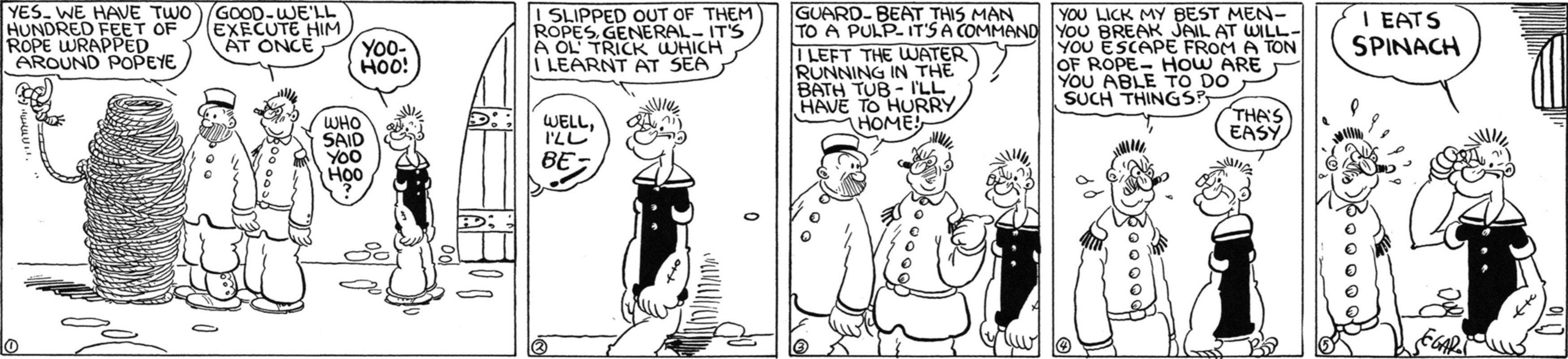
The first reference to this is in a story that began in May 1931. King Blozo of Nazilia, in the midst of a war with his neighboring nation, Tonsylania, calls on Popeye to assist him in the war effort. Popeye agrees to help, but was never one for following orders, and thus ends up having an altercation with Chief General Bunzo during which Popeye punches him in the face. Bunzo decides that Popeye must be executed for this, but Popeye manages to escape from the mile of rope the jailers tie him up with and beats up the executioners. When asked by Bunzo how he could accomplish such feats, Popeye's simple answer is "I eats spinach."
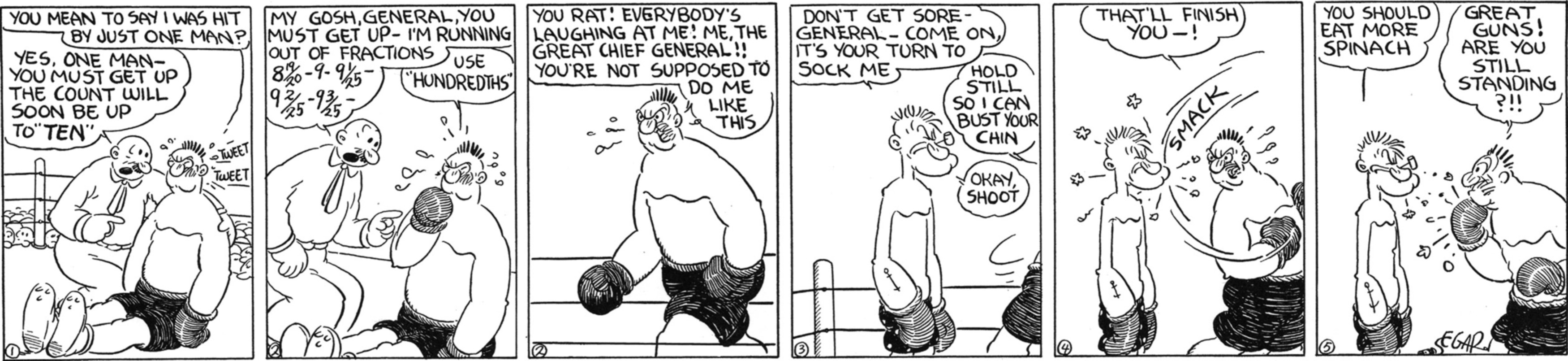
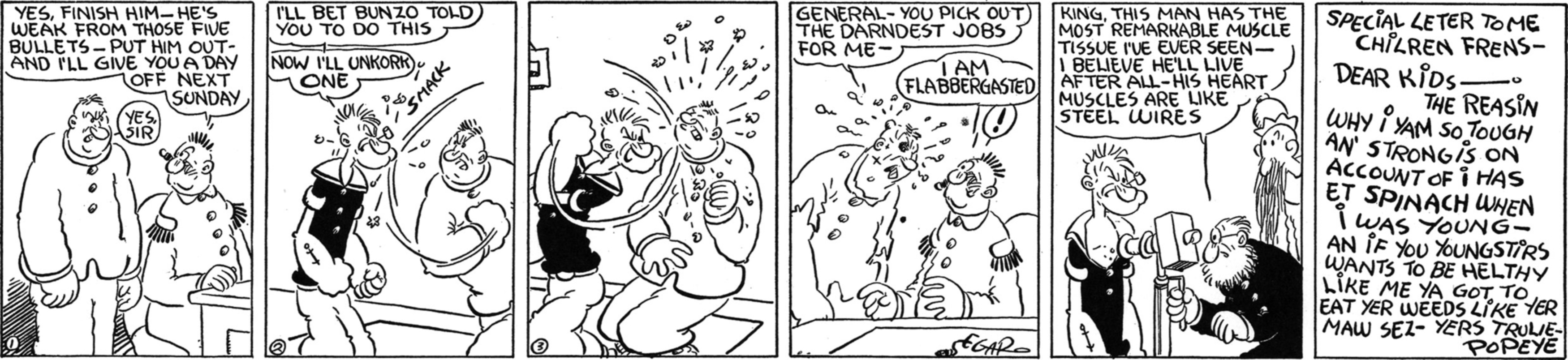
This became somewhat of a running gag for the remainder of the story. Since Bunzo was unable to execute Popeye, he decides to challenge him to a boxing match instead. During the match, Popeye is unfazed by all of Bunzo's blows, and remarks, "You should eat more spinach." As the general continues to fail to harm him, Popeye turns to the crowd and says, "Ladies and Gents - Napoleon here, can't lay me out on account of he don't eat enough spinach." The general then decides to try and execute Popeye by firing squad, but even after getting riddled with bullets he is miraculously unharmed. He goes to a doctor to get checked out afterwards, who says, "I thought they executed you!" Popeye replies, "They did, but it didn't take." After examining Popeye, the doctor says to the king, "King, this man has the most remarkable muscle tissue I've ever seen - I believe he'll live after all - his heart muscles are like steel wires." In the final panel of that strip, there’s a note supposedly written by Popeye himself which says, “Special Leter to me chilren frens - Dear kids - The reasin why I yam so tough an’ strong is on account of I has et spinach when I was young - an if you youngstirs wants to be helthy like me ya got to eat yer weeds like yer maw sez - yers trulie - Popeye”
This is most likely the story the Fleisher animators referenced when developing the version of Popeye that would appear in the cartoons. Their reasoning for slightly changing the spinach lore must have been that if spinach made him strong when he ate it years ago, it should continue to make him strong whenever he eats it now. It certainly worked, and it cemented spinach as Popeye's vegetable of choice.
Popeye has been associated with spinach ever since, and this association has led to some interesting things.
In Crystal City, TX, known as the "Spinach Capital of the World" due to spinach being a major crop grown there, a statue of Popeye was erected in March of 1937 during the city's annual Spinach Festival. It was meant to honor both the character Popeye as well as the cartoonist E.C. Segar who, it is believed, helped to increase consumption of spinach in the United States in the 1930s (we'll come back to that fact later) and thus contributed greatly to the economy of Crystal City. While the original statue is now inside city hall, a modern replacement still stands outside the city offices and is a popular tourist attraction.
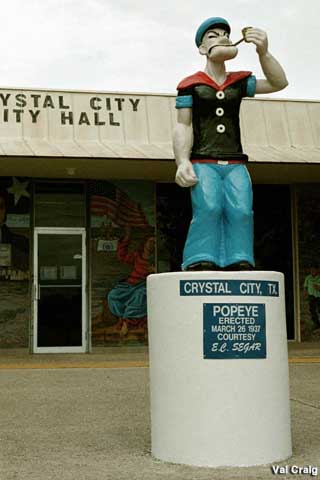
Similar statues of Popeye have been erected elsewhere, in Chester, IL, Alma, AR, Siloam Springs, AR, and Springdale, AR, though the last two are no longer standing. Chester has no association with spinach, though it is the hometown of Popeye's creator, E.C. Segar. The towns in Arkansas, on the other hand, have a deep connection with spinach, and would end up having a deep connection with Popeye.
The connection between Arkansas and Popeye would not come until a few decades after Crystal City, however.
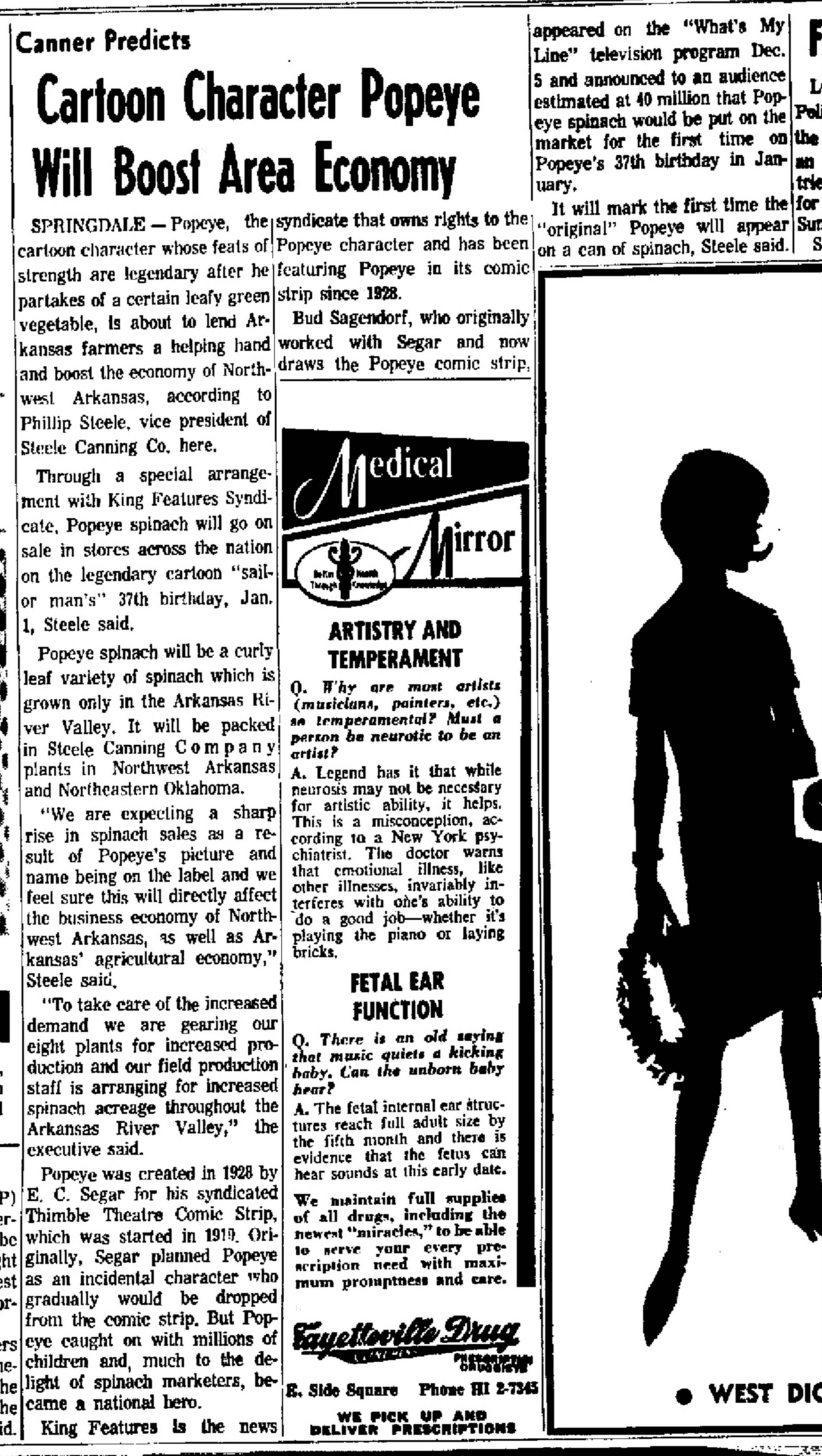
In 1965, the Steele Canning Company, headquartered in Springdale, AR, acquired a license from King Features Syndicate, who publishes the Popeye comic strip, to sell cans of spinach under the Popeye Spinach brand. Despite his long association with spinach, this would be the first time that Popeye actually appeared on any kind of spinach product. Company president Joe Steele and his son Phillip were confident that associating such a popular character with their product would increase spinach consumption, as well as boost the local economy of their city and state, which led them to seek out the license.
And yes, this was an actual, legitimate, officially licensed product, unlike other food products associated with comic strip characters that I've covered in the past. In fact, King Features themselves assisted with the marketing campaign, even sending live action Popeye actor Herb Messinger to appear at various events promoting the product. Bud Sagendorf, who was drawing Thimble Theater/Popeye at the time, also appeared on the TV show "What's My Line" to announce the product's debut.
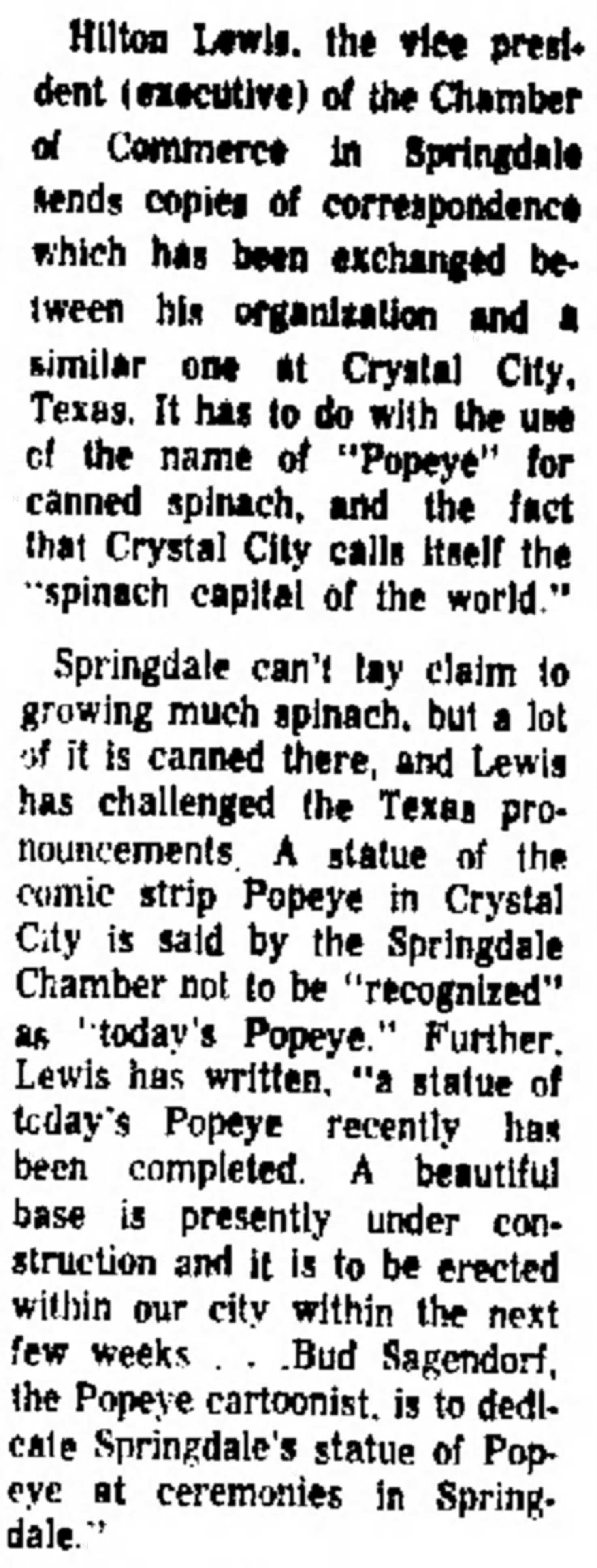
It was also around this time that the Popeye statue in Springdale was first erected, outside of the Steele Canning plant. In fact, the vice president of the Springdale Chamber of Commerce, in announcing the erection of the statue, even mentioned the Crystal City statue, challenging that city's title as "Spinach Capital of the World." Lewis said he did not recognize the Crystal City statue as "today's Popeye," which is what the Springdale statue would be. Bud Sagendorf was also present for the unveiling and dedicating of the Springdale statue.
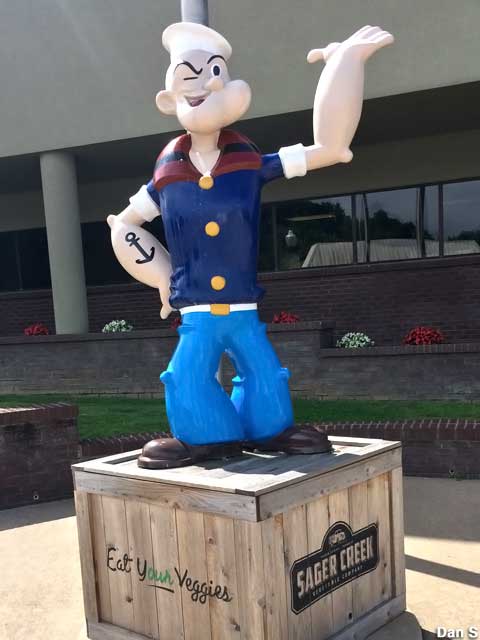
Around 1978, two years after the death of Steele Canning president Joe Steele, another Arkansas company, Allen Canning, acquired Steele Canning Company and its Arkansas canning plants. Along with the plants, it also acquired the Popeye Spinach license, and of course the Popeye statue. Allen Canning at its various Arkansas plants was at one point reportedly producing 65% of the canned spinach in the United States, much of which was at its plant in Alma. Thus, the people of Alma decided to be the next to challenge Crystal City's title of "Spinach Capital of the World."
In 1987, the town decided to rebrand itself as the Spinach Capital, painting the slogan on their water tower alongside a likeness of Popeye, and commissioning their own statue of Popeye made of papier mache, which was later given a fiberglass coating. This did not go unnoticed by residents of Crystal City. Alma resident George Bowles, one of the men who initially suggested the town be rebranded, received a postcard from a newspaper publisher in Crystal City with "Greetings from the Spinach Capital Of The World" printed on it, an obvious challenge to Alma's new title. Bowles answered the challenge by sending back a package of Popeye Spinach, along with some Arkansas water and Arkansas soil. This must have been sufficient for the residents of Crystal City, because Bowles received no further correspondence.
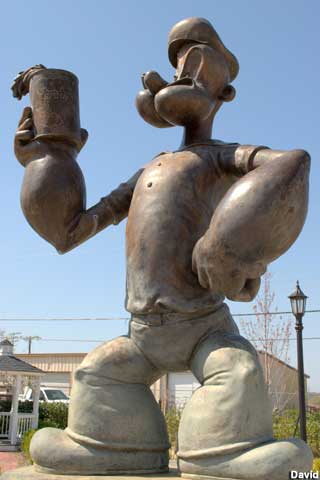
In more recent years, the Alma statue has been replaced by a sturdier bronze statue. At time of writing, the bronze statue is still standing, in the middle of a fountain at Popeye Park. The Springdale statue, on the other hand, isn't. After Allen Canning was renamed Allens Inc, the statue was moved to the corporate offices in Siloam Springs, AR. After the company went bankrupt and its brands were acquired first by Del Monte and later by McCall Farms, the statue was removed completely.
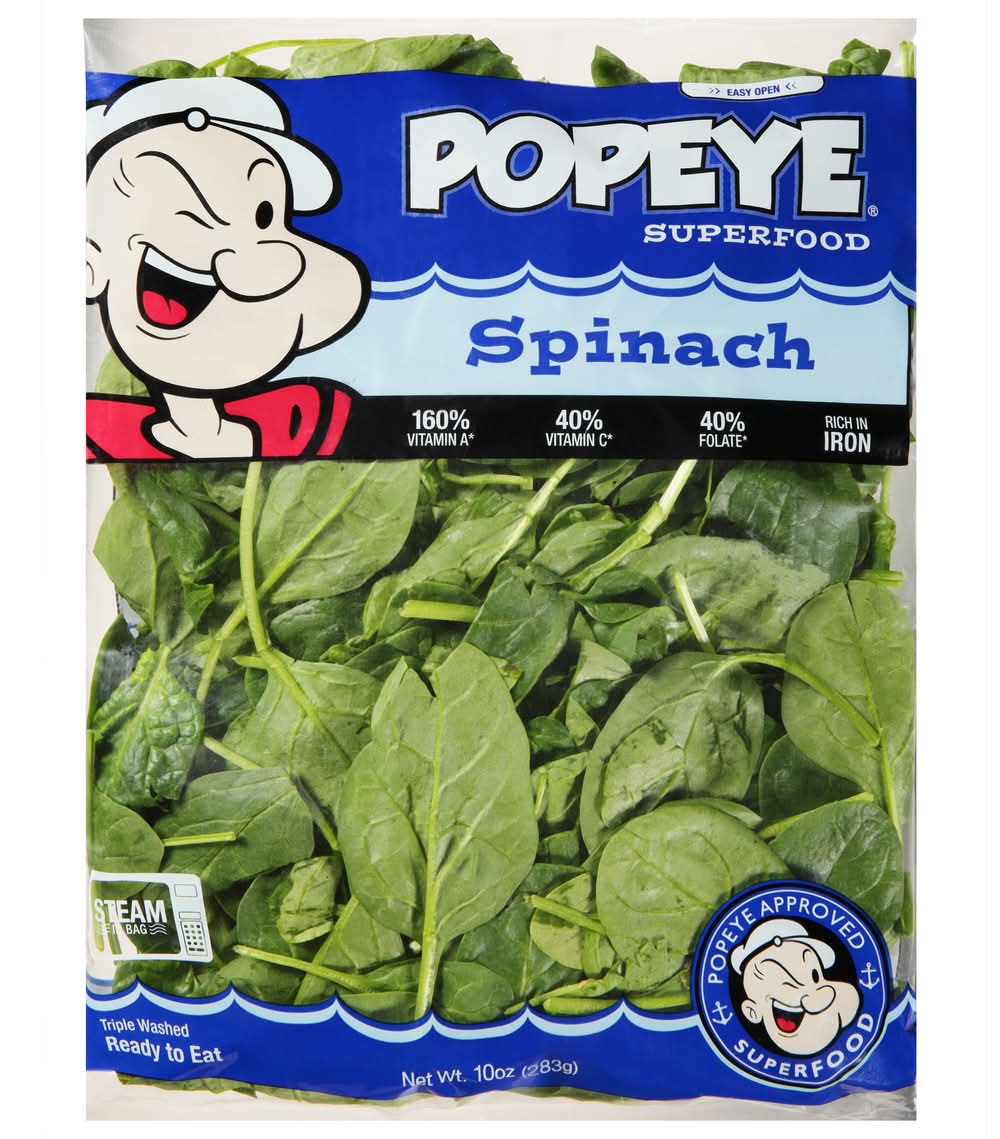
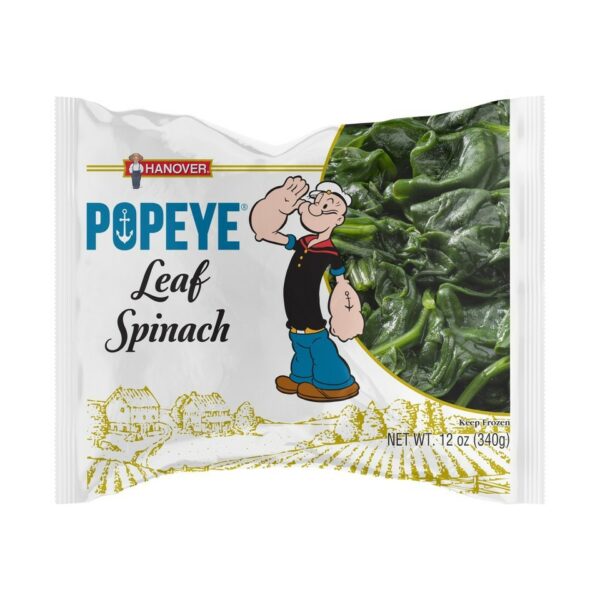
McCall Farms currently owns not only the Allens brand but also the Popeye Spinach brand, cans of which can still be found on grocery store shelves today. But cans of spinach aren't the only place you'll find the Popeye brand. While I wasn't able to find much information about them, other companies have also produced officially licensed Popeye spinach, both fresh and frozen. Popeye Fresh Spinach, branded as a "superfood," was sold by Taylor Farms, though it doesn't seem to be around anymore (and given Taylor Farms' recent troubles, I have an idea why). Hanover Popeye Frozen Spinach is still around, and carries an official King Features copyright notice, though it uses a slightly different logo than the canned version, for trademark reasons. I am unaware of either of those companies erecting Popeye statues.
Seeing all that Popeye has done for spinach and for spinach growing and spinach canning cities, you may begin to have the idea that the Popeye character has had some kind of influence on the amount of spinach consumed over the years. The reason for the Crystal City, TX Popeye statue seemed to be to thank the character for doing so. Phillip Steele said he thought the canned Popeye Spinach brand would do so. The full rebrand of the city of Alma, AR seemed to be built on this premise. The claim is even made on the official Popeye website. It says that Popeye has helped to increase spinach consumption by 33%, which is the number I found many people citing in various places.
But is it true?
The evidence suggests that it might not be. While the 33% number is cited quite often, no evidence is ever given for this claim, and it's also not made clear what time period it refers to, and if the amount of spinach consumption has stayed steady since the increase. I couldn't find where the 33% number came from, but I did find someone who actually looked at the numbers.
According to this data, between the years of 1915 and 1928, the amount of spinach grown and consumed in the United States grew significantly due to certain public health initiatives from the US government. Since Popeye was not introduced in Thimble Theater until 1929, it would not have been possible for him to have any effect on that. When Popeye began extolling the virtues of spinach in 1931, it's more likely that this was merely an extension of these already existing public health campaigns, and E.C. Segar was attempting to contribute to them. It probably wouldn't be correct to say that Popeye did nothing to influence spinach consumption, but it doesn't seem right to say he did it all on his own. The most telling point to me is how the acreage devoted to the growing of spinach increased prior to Popeye's introduction. Since there was already a much larger supply of spinach than there had previously been, it only stands to reason that the consumption of said spinach would be at least somewhat higher. By the time the Crystal City Popeye Statue went up, it seems likely that the spinach growers there were benefitting more from a couple decades of government agricultural initiatives and less from a comic strip character.
The numbers look even worse the farther into the 20th century we go. By the time Steele Canning introduced Popeye canned spinach, consumption of it was clearly in decline, and would continue to decline for the remainder of the century. While I imagine people would be more likely to buy a can of spinach if it had a popular, well-known character on it, the fact was that they were not necessarily likely to buy it in the first place.
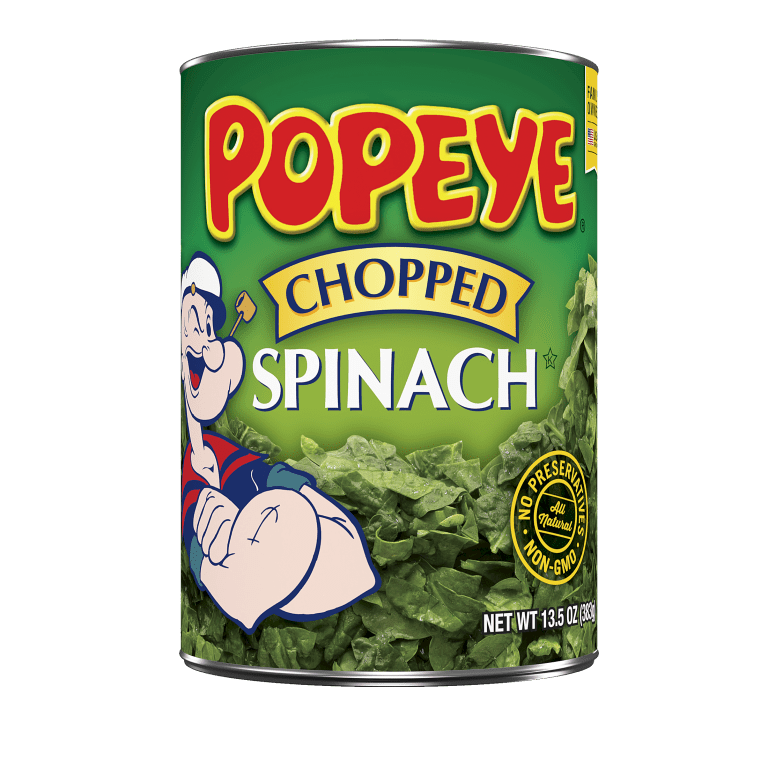
Finally, speaking of buying cans of spinach, in preparation for writing this post, I actually bought some Popeye brand canned spinach from my local grocery store because I realized I had never eaten canned spinach before. After trying some, I don't believe I will ever be purchasing it again. I like spinach if it's fresh, though I've never liked it cooked, and canned spinach tastes about as bad to me as any cooked spinach I've ever had. There was also a recipe on the back of the can for "Easy Spinach Dip," which I made in an attempt to get some better use out of the rest of the can. I had to buy another can, since the recipe called for two. The dip seemed to be designed to mask the flavor of the spinach, though I don't think it does a very good job of it. It was certainly easy to make, but not necessarily easy to eat. I would like to find some of the Hanover Popeye frozen spinach and try it as well, to see if it's any better. It would probably make for better spinach dip, at least. Unfortunately, I haven't been able to find it where I live. I'll have to settle for non-Popeye spinach for the time being.
For more information:
Official McCall Farms Popeye Spinach website
History of Popeye Canned Spinach at National Museum of American History
Popeye Statues at Roadside America
Alma, Spinach Capital of the World at Arkansas Road Stories
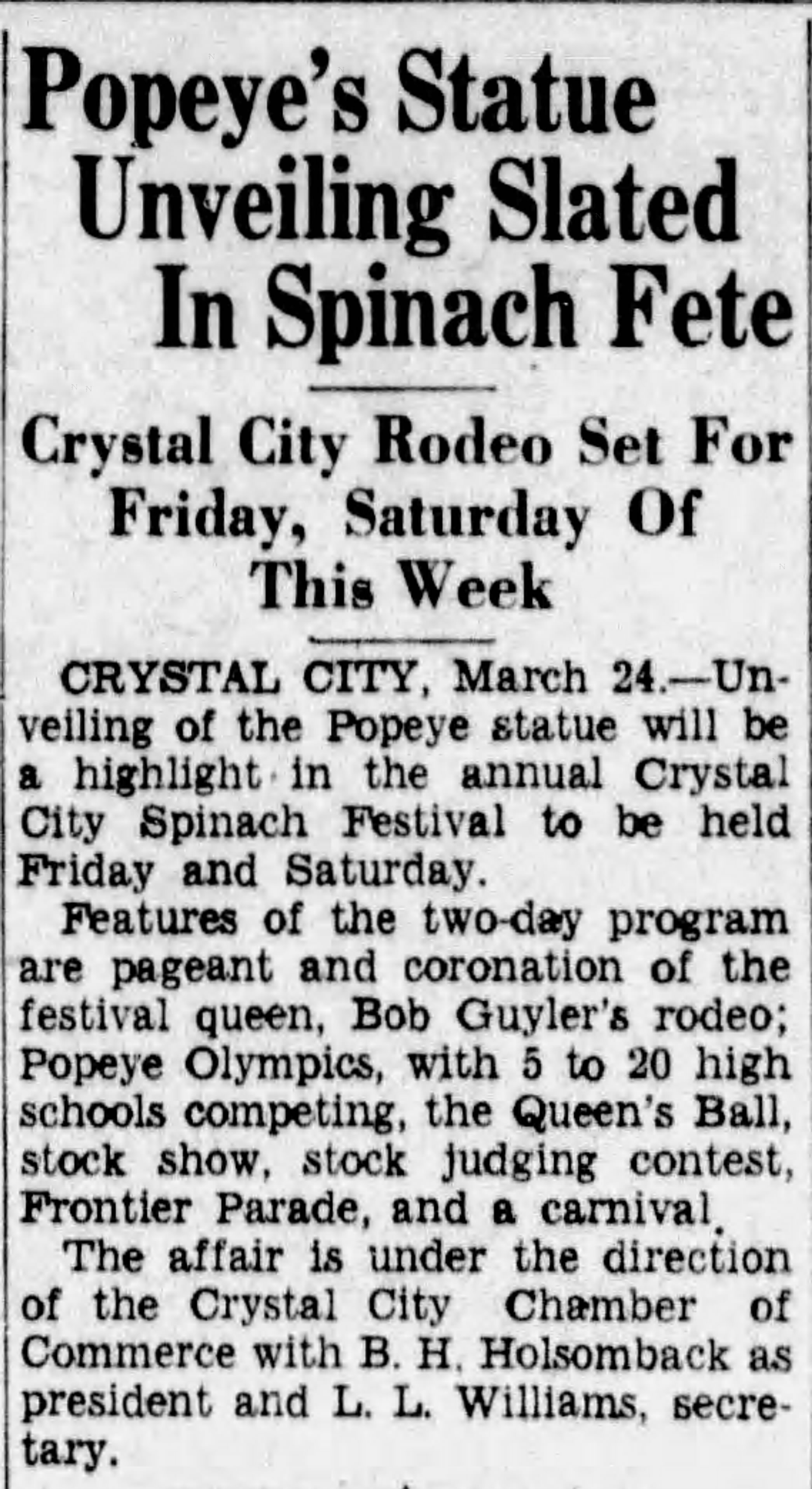
"Popeye's Statue Unveiling Slated In Spinach Fete", on the unveiling of the Crystal City Popeye Statue, from the San Angelo Morning Times
"Cartoon Character Popeye Will Boost Area Economy" on the debut of Steele Popeye canned spinach, from the Northwest Arkansas Times
Vice President of Springdale Chamber of Commerce challenges Crystal City's title as Spinach Capital of the World from the Northwest Arkansas Times