Boob McNutt, December 19, 1920

Boob McNutt, December 19, 1920

Click the image to see a larger version.

While Rube Goldberg was best known for his wacky contraptions, he was quite the prolific cartoonist, and had quite a few other comic strips over the years. One of the longest running was Boob McNutt, which revolved around a man with a good heart but with a less than stellar brain. It ran for nearly 15 years, and became a bit of a connection point between Goldberg's various strips. The titular characters in Goldberg's strip "Mike and Ike (They Look Alike)" were revealed to be Boob's uncles, Boob became acquainted with Lucifer Gorgonzola Butts, who was the "inventor" of all of Rube Goldberg's many devices, and Boob even ran into Bertha the Siberian Cheesehound, which was the topper for the Boob McNutt strip.

The strip itself normally involved someone entrusting Boob with performing a particular task and his inability to do the task without causing destruction and disaster. He's always willing to help, and looks trustworthy enough, but in the end it never works out. Such is the case here. Personally, I blame the goat for this one. What was he even doing out in the back yard in the first place?

Reg'lar Fellers, November 3, 1924

Reg'lar Fellers, November 3, 1924

Click the image to see a larger version.

The logic of children at its finest. It makes sense when you think about it, though I did have to think about it for a bit. I mean, the pole had to get there somehow, right? Of course, we know that the first man to place the pole up there must have been Santa Claus. Pop isn't that far off when he says that it was about ten years before this strip was published that anyone successfully reached it, though it might be closer to fifteen. The tradition of Santa Claus living there probably came about in the 19th century, so I'd say the answer to Jimmy's question is probably around 60 or 70 years.

This strip, unlike the one from yesterday, was actually done by Gene Byrnes, and when you compare the two you can certainly tell the difference. The line work in Byrnes' strips is much more crisp, and the hatching is exquisite. The ghost artists did a great job of capturing the feel of Byrnes' artwork, but it's no substitute for the real thing.

Reg'lar Fellers, November 11, 1948

Reg'lar Fellers, November 11, 1948

Click the image to see a larger version.

Reg'lar Fellers, created by Gene Byrnes, first appeared under that name in 1920 and revolved around the gang of kids you see here. They were supposed to be suburbanites, but oddly enough speak exactly like kids from Byrnes' native New York City. The strip lasted until 1949, meaning this particular strip was one of the later ones that, while still signed by Byrnes, were not written or drawn by him. This one was ghosted by George Carlson. It was very popular in it's time, and spawned books, comic books, animated and live-action films, and a radio show. The strip is very charming and enjoyable, and definitely has a well-deserved place among the best of the comic strips about kids.

This one does bring up a good question, though: What does Santa Claus do the rest of the year? I don't imagine he's just sleeping the whole time, but if your job really only takes one night of the year, and you're a magical being, it must be difficult to fill the rest of the time.

Nancy, December 8, 1955

Nancy, December 8, 1955

Click the image to see a larger version.

The problem with this, of course, is that you'll probably end up with frozen grape soda. If you actually want to drink it you'd have to plan in advance so you could thaw it out. Hopefully by then it won't be flat. Actually, the more I think about it, the worse of a plan this seems to be...

Nancy, December 12, 1955

Nancy, December 12, 1955

Click the image to see a larger version.

It's actually getting kind of cold down here in Georgia, though not cold enough to do that. I do wonder why Sluggo carries a water pistol around with him in the wintertime, though. Maybe he planned on playing a prank on someone. Maybe Nancy's contrarian attitude saved her from being the recipient of that prank...

Nancy, December 17, 1955

Nancy, December 17, 1955

Click the image for a larger version.

You can never be too careful in the snow. You never know what projectiles could be hurled at you, intentionally or not. Nancy is right to prepare, though I'd expect she'd do the exercises as well as wear some kind of body armor. I know I would.

Nancy, December 23, 1955

Nancy, December 23, 1955

Click the image to see a larger version.

Pee Wee is a smart businessman. You've got to find every way to save on overhead costs. Unfortunately, he doesn't quite understand supply and demand yet, I don't think.

Nancy, December 29, 1955

Nancy, December 29, 1955

Click the image to see a larger version.

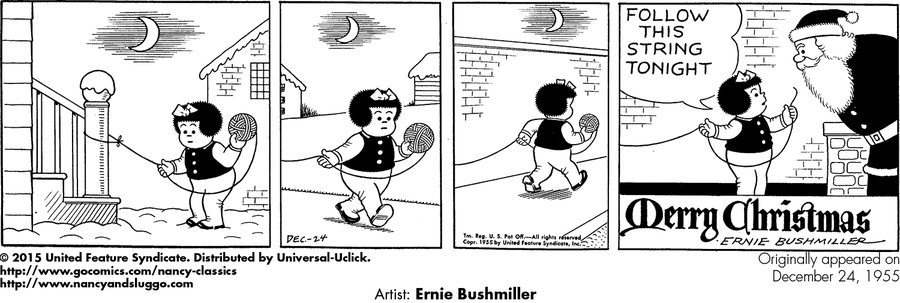
The past two years, I've posted Christmas themed comic strips during December, so I thought I'd make it a tradition and do it again this year. We start with a not necessarily Christmassy but definitely wintery themed Nancy strip. I love Ernie Bushmiller's Nancy, mostly because of its simplicity. After Bushmiller died in 1982, a few other creators have done admirable runs on Nancy, but none of them have the spirit of the original. Mark Lasky did the best at capturing the look of the artwork, but that was about it. I quite like Jerry Scott's version, but it might have been better served by being a separate comic strip entirely, because it certainly feels like it is. Guy Gilchrist, who does the strip currently, does fine, but it feels very generic. Bushmiller's is still the best. You might not think so from this fairly simple example, but you will as the month goes on.

This year, I also discovered the Scott McCloud invention Five Card Nancy, which I feel like I should have known about much earlier. It might be a nice game to play with your family on Christmas Eve or something. Also, if you don't want to go through the trouble of preparing physical cards, there's also a handy online version.

Unexpected Comic Strip Creators - Dashiell Hammett

For the most part, comic strips are created by people who are mainly known for creating comic strips. The lay person who is not well-versed in comic strip history may not even know the names of the creators of most of the comic strips they read, and if they do know them they don't know them for anything else. There are, however, some comic strips that were created by people who were famous for other, entirely unrelated things. Sometimes this is because they had a personal interest in creating a comic strip and in doing something different from what they had been doing. Other times it's because a newspaper syndicate wanted a big name in order to promote their new feature.

Such is the case with Dashiell Hammett.

Hammett is mainly known for his novels about hard-boiled detectives (a term supposedly coined by Tad Dorgan) such as The Maltese Falcon and The Thin Man. If you haven't read him, you certainly know the Humphrey Bogart version of his character Sam Spade from the movies. This was popular stuff in the 20s and 30s, and just like sci-fi adventures, it was beginning to leak over from the pages of pulp magazines onto the newspaper comics page. In 1931, Dick Tracy had begun in The Chicago Tribune, and was the biggest detective adventure comic at the time. After it had run for a few years and its popularity was apparent, King Features Syndicate wanted to have a feature to compete with it, much like they would do soon afterwards when they commissioned Flash Gordon to be created to compete with the Buck Rogers strip. In both cases, they hired Alex Raymond to do the artwork, though he was too obscure a name at the time. They needed a name on the feature that readers would recognize immediately, and thus immediately recognize the strip as a quality feature. They offered the job to Hammett, who, as luck would have it, was looking for new places to publish his work and readily accepted the offer.

The problem, however, was that it seemed King Features also wanted a writer they could control, and that was something Hammett was certainly not. He was used to writing stories about private detectives, which is why they hired him. For some reason, though, King Features really wanted a strip about a secret agent, not a private detective, and in order to reflect this there were substantial rewrites by the syndicate each time Hammett turned in his scripts. Because of this, it was very difficult to tell what exactly Secret Agent X-9 really was. He was a secret agent, but the agency he worked for was never revealed. He was also a private detective, but he only worked as one as a cover for his secret agent job. He acts like a detective and solves murders, yet the police don't seem to know who he is. It all ended up being quite the mess, and Hammett left the strip after less than a year. Raymond left a year after that, though he continued on several other King Features projects, including Flash Gordon, Jungle Jim, and his own comic strip about an actual private detective, Rip Kirby.

Interestingly, Secret Agent X-9 still continued under several other writers and artists for 60 more years, ending in 1996. After Hammett left, X-9 became a full-fledged secret agent. Later on, his name was revealed to be Phil Corrigan, and the name of the strip was even changed to "Secret Agent Corrigan". It was never extremely popular, but it is amazing that even after an incredibly shaky start it had quite a long run.

For more info:

Secret Agent X-9 at Toonopedia

Secret Agent X-9 at Thrilling Detective

Comic Strip History - Tad Dorgan

I've written previously, a few times, about language and idioms that first appeared in comic strips. For the most part, cartoonists are known for one or two things that they popularized and which have stayed around for years. Rube Goldberg had his machines, Al Capp had Sadie Hawkins Day, and George McManus had his newlyweds. Some, like Billy DeBeck, have a few more.

Then there's Tad Dorgan.

Dorgan was a cartoonist in the early 20th century who was best known at the time for his sports comic strips, such as "Indoor Sports", as well as his comic strips about dogs, like "Judge Rummy" and "Silk Hat Harry". He always signed his work as "TAD," although those were actually his initials. His real name was Thomas Aloysius Dorgan.

He is also a problem. He's credited, in more than one place, with either coining or popularizing a very large number of phrases and idioms. Some of them have gone out of style, some are still in common usage, and some have gone out of usage and have had a resurgence. As a comic strip history enthusiast, it's exciting to me to think that a single cartoonist has has that much of an effect on the language, in the short term and the long term. The problem, however, is that while he's credited with these, it isn't exactly clear whether he actually coined or popularized any of them.

Lots of places think they can fudge history by saying someone "popularized" a word or phrase, basically saying that while they may not have come up with it, they used it a lot and were instrumental in spreading it around. As quite a prolific cartoonist, his work was seen by millions on a daily basis, for many years, and therefore it stands to reason that any popular phrase he wrote would easily be spread. I just get a little suspicious when the list of things he "popularized" becomes as large as it is.

Here's what Wikipedia lists:

  • "dumbbell" (a stupid person)
  • "for crying out loud" (an exclamation of astonishment)
  • "cat's meow" and "cat's pajamas" (as superlatives)
  • "applesauce" (nonsense)
  • "cheaters" (eyeglasses)
  • "skimmer" (a hat)
  • "hard-boiled" (tough and unsentimental)
  • "drugstore cowboy" (loafers or ladies' men)
  • "nickel-nurser" (a miser)
  • "as busy as a one-armed paperhanger" (overworked)
  • "Yes, we have no bananas"
  • "Twenty-three, Skidoo"
  • "solid ivory"
  • "Dumb Dora"
  • "finale hopper"
  • "Benny" (a hat)
  • "dogs" (feet or shoes)

Now, as an example of how untrustworthy this list can be, let's look at Dumb Dora, a 1920s phrase for a woman who wasn't too bright. If any cartoonist should get credit for this one it's Chic Young, creator of Blondie, who created a comic strip in 1924 called Dumb Dora that was popular in its day. However, around the same time, Burns and Allen had been popularizing the phrase in their vaudeville act, and there had also been a movie by that name. Who knows where the popularization came from?

Then, of course, there's "hot dog." While it's been widely debunked, Dorgan is in several places still credited with first using the term to refer to a sausage at a New York Giants baseball game. The term, however, has been shown to be in usage at least 10 years before Dorgan ever used it in a comic strip.

The same goes for a number of these. There are other explanations for where they were coined and popularized, but somehow Tad Dorgan gets lumped in with them, probably because he was simply using popular language of his time. Now, I'm not saying that he didn't coin any of them, but the evidence certainly isn't good that he coined all of them.

I think of it like medicine: If a medicine or medical treatment claims to treat one particular symptom, it's much safer to believe that it legitimately does. If it claims to heal and cure a ridiculously large list of symptoms, it's probably safe to at least be extremely skeptical of its claims. While I enjoy Dorgan's work, and while I respect him as a prolific user of slang in a popular medium, I don't think he deserves all the credit that he's given.