Blog: christmas 2025

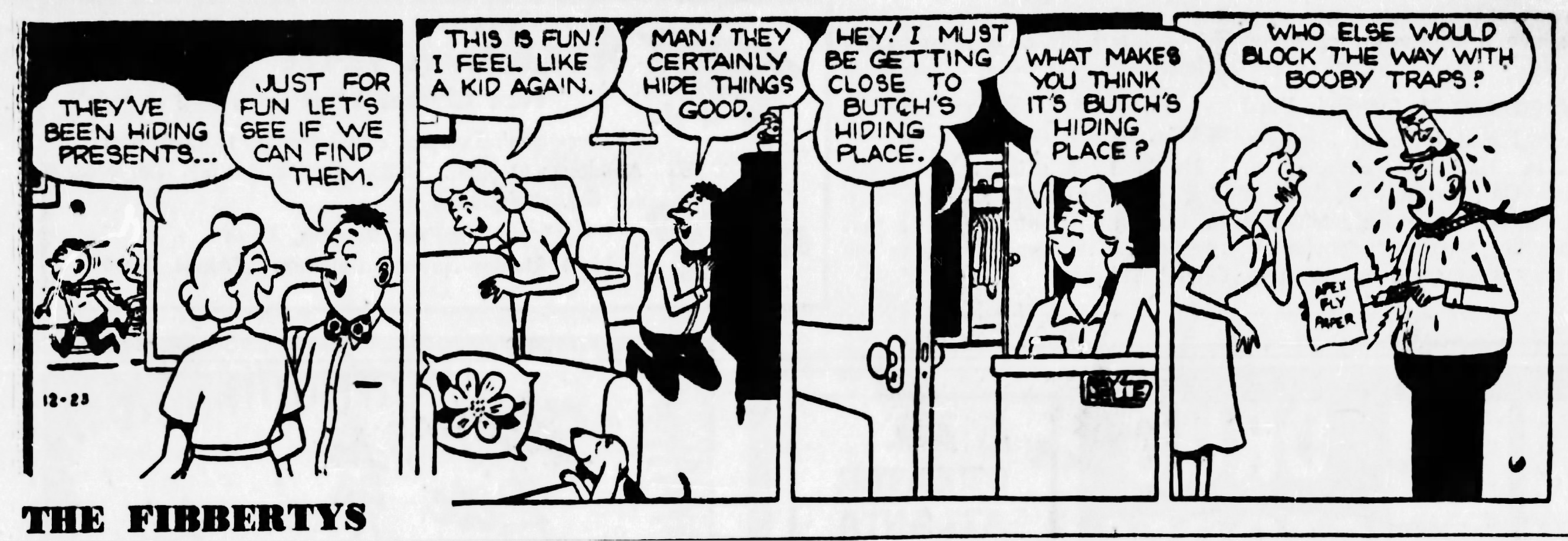
The Flibbertys, December 23, 1954

The Flibbertys, December 23, 1954

Click the image to see a larger version.

The Flibbertys (misspelled here as "The Fibbertys") was a comic strip created by Ray Helle in September 1954, and which ran until 1972. It concerned a family named the Flibbertys, consisting of mother and father Fran and Stan, children Wendy, Butch, and Sis, their dog Geddown, and their cat Preston. Geddown and Preston had dialogue balloons, but it didn't mean they could "talk." Any dialogue they had could only be understood by other animals, and not any of the human characters. Unlike a character like Snoopy or Garfield, these were not thought bubbles, but actual dialogue balloons, so it makes you imagine that they are actually speaking, just in a different language perhaps.

I find it interesting that in this strip the parents are looking for where the kids hid the presents, when usually it's the other way around. I think Butch has the right idea, too. You should set booby traps in your hiding places, especially if you can't find anywhere good and all of the places that are available are the really obvious ones.

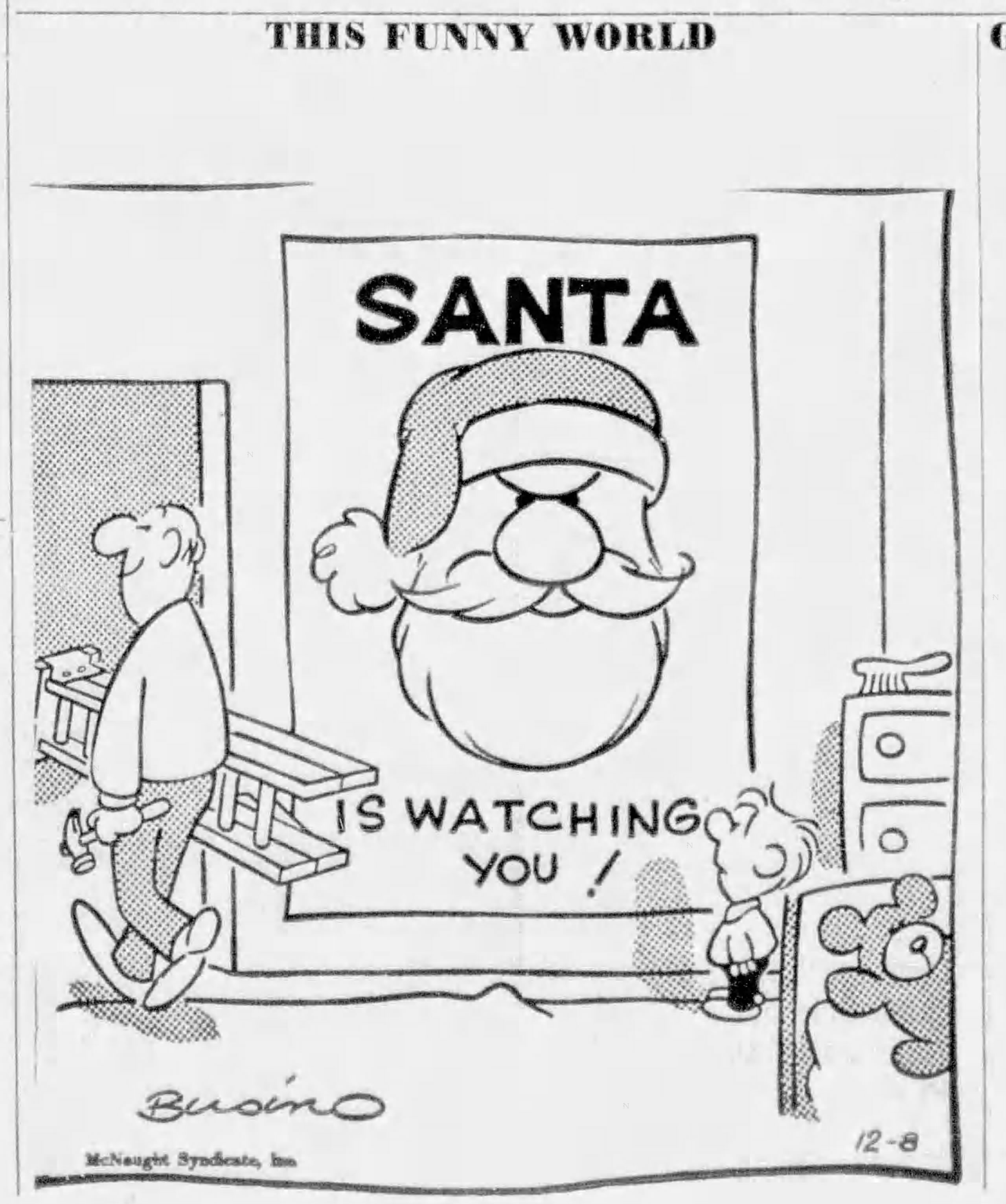
This Funny World, December 8, 1967

This Funny World, December 8, 1967

Click the image to see a larger version.

This Funny World was an interesting strip. There was no consistent cartoonist, because it essentially reprinted single panel gag comics from various popular magazines. Due to it being copyrighted to Collier's Magazine, Allan Holtz surmises that rather than being reprints, the panels were potentially rejected magazine submissions. It's possible, but seeing as how it outlived Collier's, running from 1945 all the way to 1985, I'm skeptical of that explanation. It's an interesting idea for a newspaper comic nonetheless.

Not much to say about this one. It certainly looks like it could be in a magazine. I like the smug look the man has as he walks away. I wonder where he got a poster of that size.

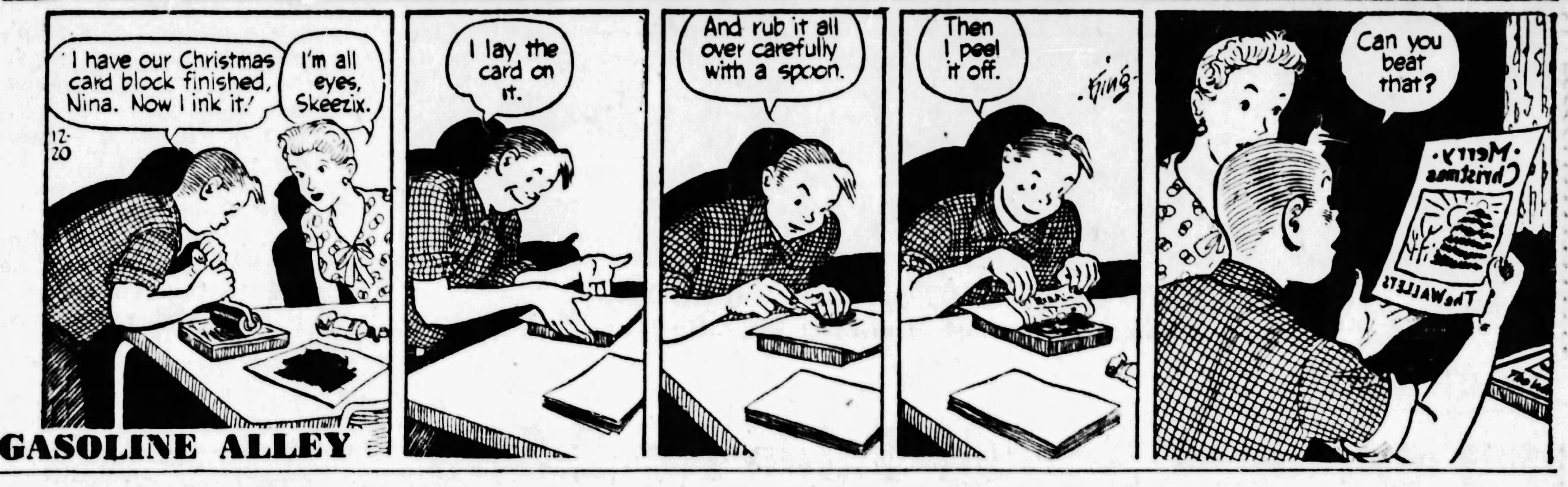
Gasoline Alley, December 20, 1954

Gasoline Alley, December 20, 1954

Click the image to see a larger version.

Gasoline Alley has been featured several times on this blog before, but it just continues to be a wonderful source of Christmas themed strips, so I keep going back to it. While it was created by Frank King in 1918, after King's death in 1969 it was carried on by a succession of different cartoonists and continues to this day. In fact, in just three more years, when it reaches its 110th year of publication, it will surpass The Katzenjammer Kids as the longest running newspaper comic.

Here we have an example of one of the later Frank King strips, and one that I can certainly relate to. I love making hand-made Christmas cards for my family, and in the past have actually considered doing either a wood block or linoleum block print for them. It would certainly make reproducing them multiple times for all my siblings easier. I may consider it again for next year. I did quite a lot of printmaking in college, so I'm familiar with the process that Skeezix shows off to Nina here. The only part that he forgot, of course, is that you have to carve the letters into the block backwards, so that they read forwards when you stamp it onto the paper. You have to retrain your brain a bit in order to make the letters wrong so they will be right later. I certainly made that mistake when I was first starting out. In fact, my senior art project included some woodblocks, and I even made that mistake on one of those pieces as well. There was someone yelling "AAAAAAAA!" and I put the exclamation point on the wrong side of the exclamation. I hope no one noticed.

Big Sister, December 21,1954

Big Sister, December 21,1954

Click the image to see a larger version.

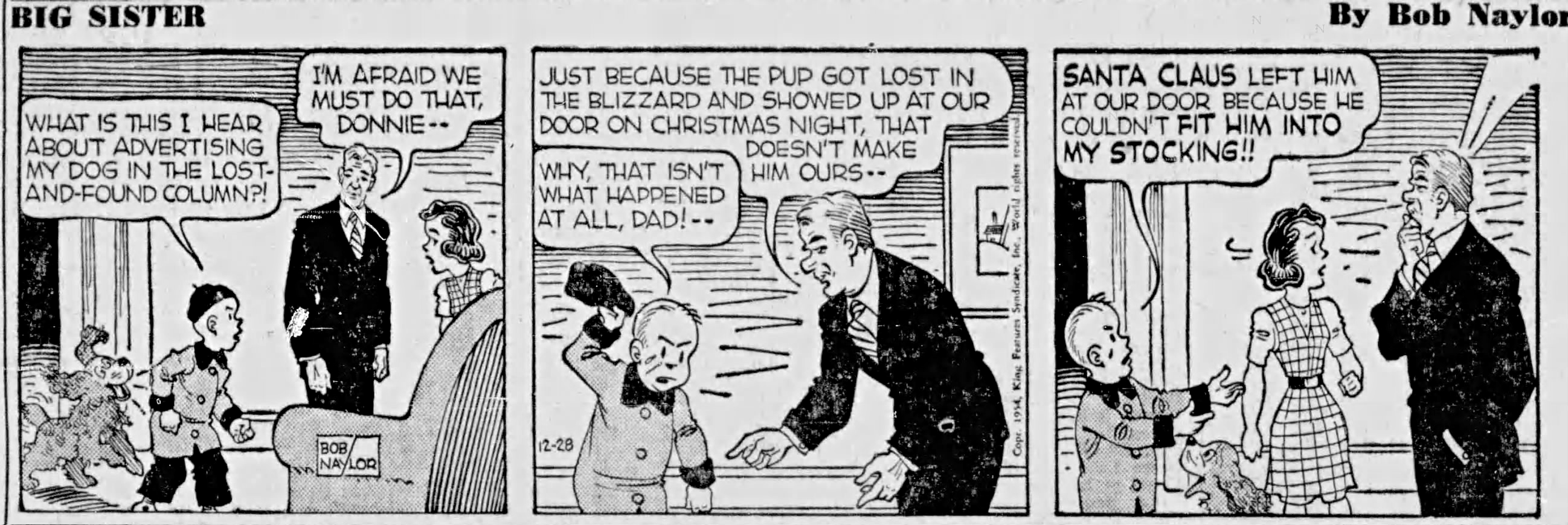
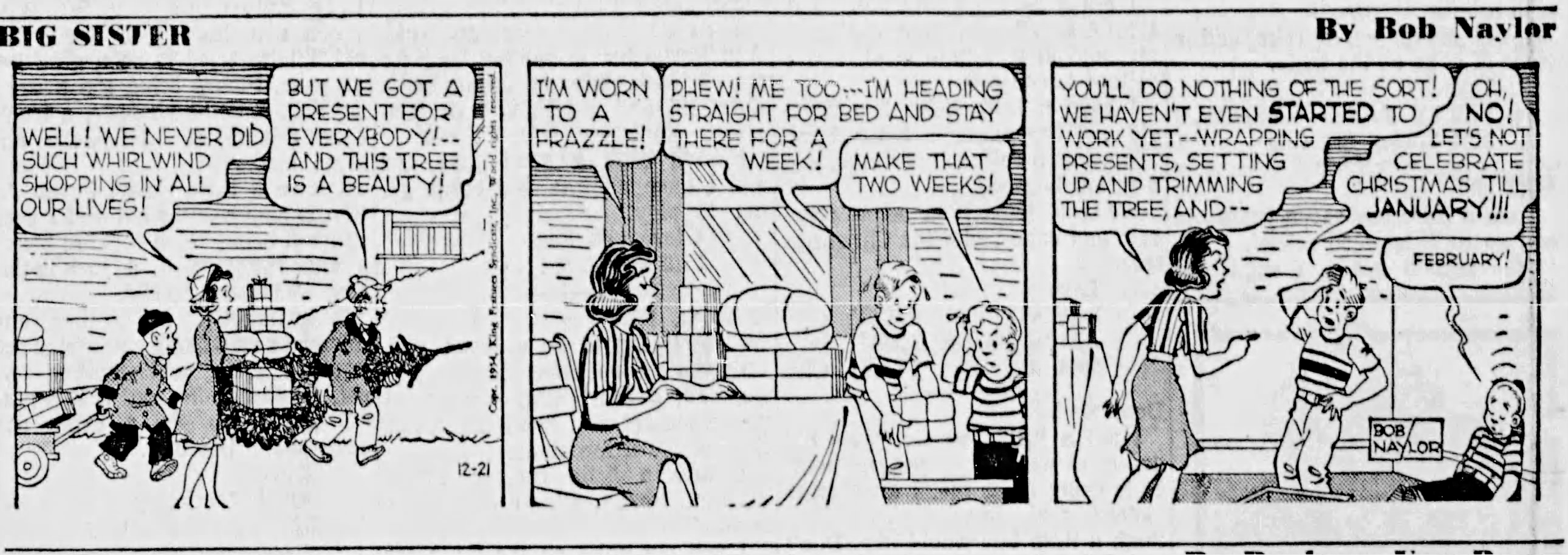
Big Sister was created by Les Forgrave in 1928. Forgrave wrote and drew it until his death in 1953. It was taken over by his assistant, Jimmy McMenamy, who also died shortly thereafter, after which it passed to Bob Naylor. It ran until Naylor retired in 1972. The strip concerned a family of four, consisting of a father and three children. The father was a widower, so the titular big sister, Phoebe, took it upon herself to be the mother figure for her two younger brothers, Buddy and Donnie. Phoebe is mature beyond her years, and takes her role in the family very seriously (perhaps too seriously at times).

Today's example is from the Naylor years, and displays Phoebe's personality quite well. When I first read this while searching for strips to post this month, without even knowing the overall backstory, I could already tell the kind of relationship she was supposed to have with her brothers, and the role that she played. I wouldn't necessarily call her bossy, but she certainly acts with authority in the household, as we can see here.

I can understand how the boys feel here. A lot of preparation can go into a holiday or other important occasion, and often by the time the preparation's done you've had so much of the holiday already that you don't even feel like celebrating it. Still, I'm sure that after the boys have a break and then sleep on it, they'll be ready for some more Christmas the next day.

The Toodles, December 20, 1953

The Toodles, December 20, 1953

Click the image to see a larger version.

The Toodles was a domestic, family comic strip written by husband and wife team Stanley and Betsy Baer, and drawn by Rod Ruth. Betsy was the daughter of cartoonist Sol Hess, known for creating the comic strip The Nebbs. Betsy and her husband disagreed with Sol about the way he did things in his strip, and so to prove a point, they started a comic strip of their own. It started in 1941 and ran until 1961. Unfortunately, Sol Hess died the very month that the strip debuted, so they were unable to truly prove him wrong. The Bell Syndicate, who published The Nebbs, certainly took notice, though, and hired them on to continue writing the strip after Hess's death. Since they were writing two comic strips at once, they couldn't resist the temptation to have them cross over, and the Nebbs and the Toodles began visiting each other from time to time. Even when The Nebbs ended and The Toodles was still running, the Nebb family would still show up to visit the Toodle family occasionally.

Here we see the youngest members of the Toodle family, the twins Penny and Pat, who were probably the most popular characters in the strip. The way they imagine Santa Claus is very interesting. I don't think I've seen very many fantasies where Santa looks stressed and overworked. He has all those elves to help him, after all. He's also magical, which I imagine would make it easier to do at least some of the tasks that he has to do. Still, Pat's theory about Santa's beard could be correct. It seems Santa's elves are often depicted with beards, too, so they probably don't have a lot of time to shave either. Perhaps instead of leaving milk and cookies for Santa this year, leave him a razor.

Moon Mullins, December 20, 1941

Moon Mullins, December 20, 1941

Click the image to see a larger version.

Kayo once again needs to borrow money in order to buy a Christmas present, and Mamie is kind enough to be the first to contribute, even though the gift is for her. Perhaps she thought that the residents of the boarding house and the surrounding city would be as kind as the people that work in Smitty's office. As we see, this is not necessarily true.

For those unfamiliar with Moon Mullins, Willie and Mamie are Moon and Kayo's aunt and uncle, and Mamie works for the Plushbottoms, owners of the boarding house, as a washerwoman. Willie... doesn't work, and is portrayed as lazy and shiftless. He also seems to have a magnetic pull towards anyone with small amounts of cash. As soon as Kayo walked outside with that quarter, Willie pounced on him and convinced him to give it up. I guess he figured it would be easier than asking his wife.

Side Glances, December 3, 1953

Side Glances, December 3, 1953

Click the image to see a larger version.

Side Glances was a comic panel created by George Clark in 1928, which ran all the way up to 1985. Clark wrote and drew it up until 1939, when he started working for a different syndicate and continued writing and drawing a similar panel under the title The Neighbors. Side Glances was taken over by William Galbraith Crawford, who always signed his work with his middle name, as we see in this example. Crawford was an illustrator for magazines and movie posters, and had published cartoons in the New Yorker on many occasions, so he was a nice fit for the single panel format. I wasn't able to find much information about him on the Internet, but apparently his work is popular on art auction websites.

As for this particular panel, I think it's safe to say that this boy is going to be getting an electric train for Christmas whether he wants one or not. I've never had kids, but I imagine one of the joys of Christmas is giving them things that either you never had as a kid but wanted, or things that you want now that you can't justify buying for yourself otherwise. The kid might have fun with it, but when they stop having fun then you can take it. Or if they don't like it, you can have it for yourself immediately. It's a win-win situation.

Smidgens, December 05, 1967

Smidgens, December 05, 1967

Click the image to see a larger version.

Another Christmas obscurity, Smidgens was created by Bob Cordray in 1961 and ran until 1974. According to Allan Holtz, it ended because the syndicate that carried it, National Newspaper Syndicate, closed its doors the same year. Smidgens didn't get picked up by any other syndicate, so Cordray decided to create a new strip called "Alex in Wonderland" which had different characters but the same basic feel as Smidgens. Both strips feature fairly simple visuals, but the focus seems to be more on the clever jokes and wordplay. Unfortunately, people didn't like his second strip nearly as much as the first one, and it only lasted from 1975 to 1980 (though reprints were offered all the way up to 1986).

Regarding today's strip, I am happy to say that I've never gotten pneumonia, but when the weather starts getting colder I tend to get some kind of sickness. At least, I have noticed in years past that I get sick around this time of year. It could have something to do with the cold, but it could also be that I used to work an open concept office constantly surrounded by a bunch of people who are potentially sick, and who have run out of sick time so they have to go to work whether they're contagious or not. Since I work at home now, I don't have to deal with that problem anymore. Either way, I haven't gotten sick yet this year (fingers crossed), so I hope that when January rolls around and it gets even colder, I won't get sick then either.

Off the Record, December 18, 1938

Off the Record, December 18, 1938

Click the image to see a larger version.

A few years ago, I posted an Off the Record comic during December, which caused confusion when I looked up information about its creators. A certain trusted source, Lambiek Comiclopedia, listed Carl Kuhn as the creator of the strip in 1935, which Ed Reed took over at a later time. It doesn't say when he took it over, but seeing as today's strip is from 1938 and is credited to Ed Reed, it couldn't have been that long after it debuted. I have a feeling that Lambiek may be incorrect. I guess I'll have to do further research...

That aside, one of the strips within the strip was "The Three Bares," which featured the three babies seen here as recurring characters. I think it's a clever idea to place the "Do Not Open Until Christmas" sign on the castor oil, but it may end up backfiring on them. If they have to take that on Christmas, it may not end up being so merry.

Lolly, December 5, 1965

Lolly, December 5, 1965

Click the image to see a larger version.

Lolly, by Pete Hansen, was a comic strip about a young woman named Lolly who lived with her grandmother and her kid brother Pepper. It ran for a respectable 28 years, from 1955-1983. Hansen was an animator at Disney for a few years in the late 1930s and early 1940s, and had tried his hand at comic strips previously with a short-lived strip titled "Flapdoodles." Not long after that strip was canceled, he began work on Lolly. After Lolly ended, he went back to work for Disney, this time in the comics department.

Lolly's younger brother Pepper didn't steal the show from her in the way that certain other comic strip kids like Nancy or Herby did from Fritzi Ritz and Smitty, though the Dell Comics reprint series Lolly and Pepper did put him in the title. He was featured on his own from time to time, though, as we see here. While the joke is, of course, that the Santa he sees on the street isn't the real Santa Claus, Pepper should rest assured that since Santa knows when you've been bad or good, bringing the hat (and beard) back to the fake Santa will be counted as a good deed in his favor. He should probably put a coin or two in the "Give" box for good measure, though, just to be safe.