Blog: christmas 2025

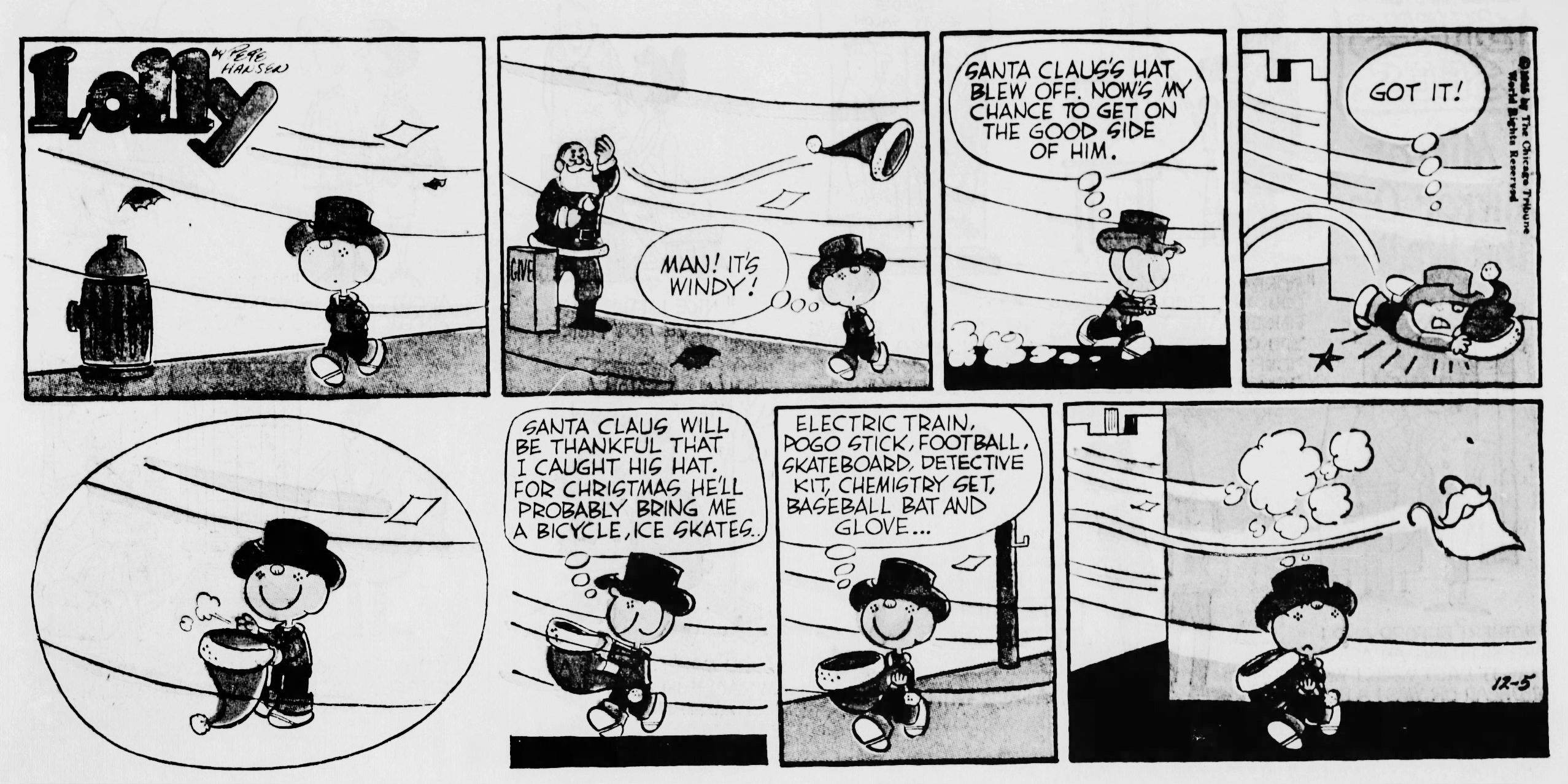
Lolly, December 5, 1965

Lolly, December 5, 1965

Click the image to see a larger version.

Lolly, by Pete Hansen, was a comic strip about a young woman named Lolly who lived with her grandmother and her kid brother Pepper. It ran for a respectable 28 years, from 1955-1983. Hansen was an animator at Disney for a few years in the late 1930s and early 1940s, and had tried his hand at comic strips previously with a short-lived strip titled "Flapdoodles." Not long after that strip was canceled, he began work on Lolly. After Lolly ended, he went back to work for Disney, this time in the comics department.

Lolly's younger brother Pepper didn't steal the show from her in the way that certain other comic strip kids like Nancy or Herby did from Fritzi Ritz and Smitty, though the Dell Comics reprint series Lolly and Pepper did put him in the title. He was featured on his own from time to time, though, as we see here. While the joke is, of course, that the Santa he sees on the street isn't the real Santa Claus, Pepper should rest assured that since Santa knows when you've been bad or good, bringing the hat (and beard) back to the fake Santa will be counted as a good deed in his favor. He should probably put a coin or two in the "Give" box for good measure, though, just to be safe.

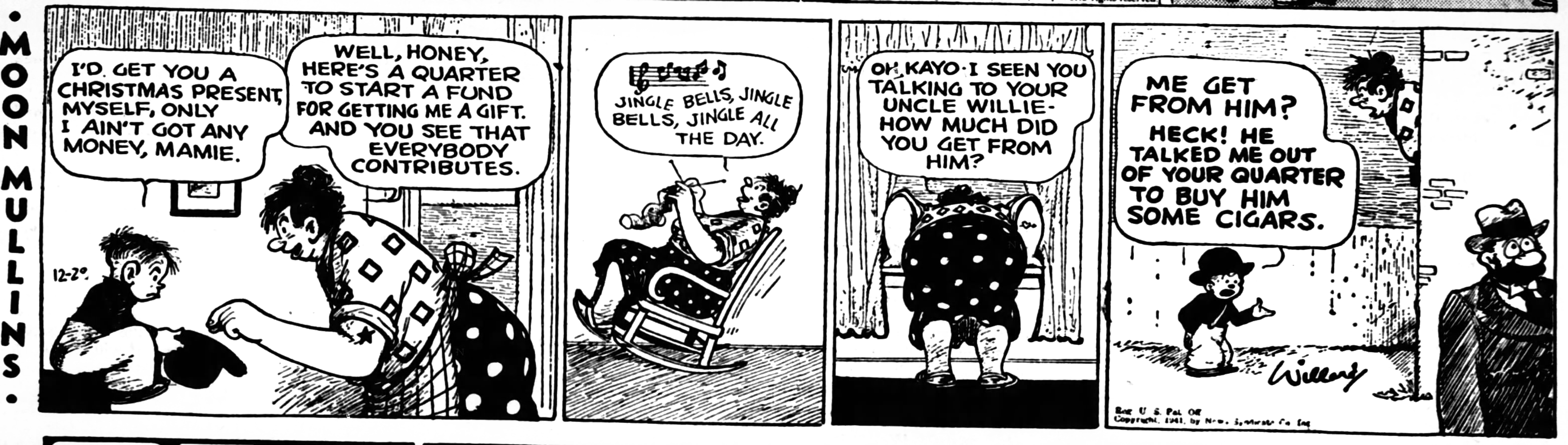
Smitty, December 20, 1953

Smitty, December 20, 1953

Click the image to see a larger version.

Smitty started life in 1922 as a 13-year-old office boy (you may have seen him on this blog before). Here we see him in 1953, still working in the same office, though he has grown at least a couple years in the last three decades. Over the course of the 52 year run, Smitty would grow a full 10 years, though it seems that no one else in the strip would. The office girl Ginnie stayed the same age and Smitty eventually married her. Smitty's younger brother Herby also stayed the same age, and after Smitty and Ginnie married they became Herby's guardians. It's very odd how time works in comic strips.

I don't know a whole lot about the boss character, but everyone in the office seems to like him enough to want to chip in to get him a Christmas present. Or perhaps Smitty is just very convincing. Or maybe they think if they get him a present then he'll be nicer to them, or pay them better, or give them a lighter work load. It doesn't seem like that worked out very well.

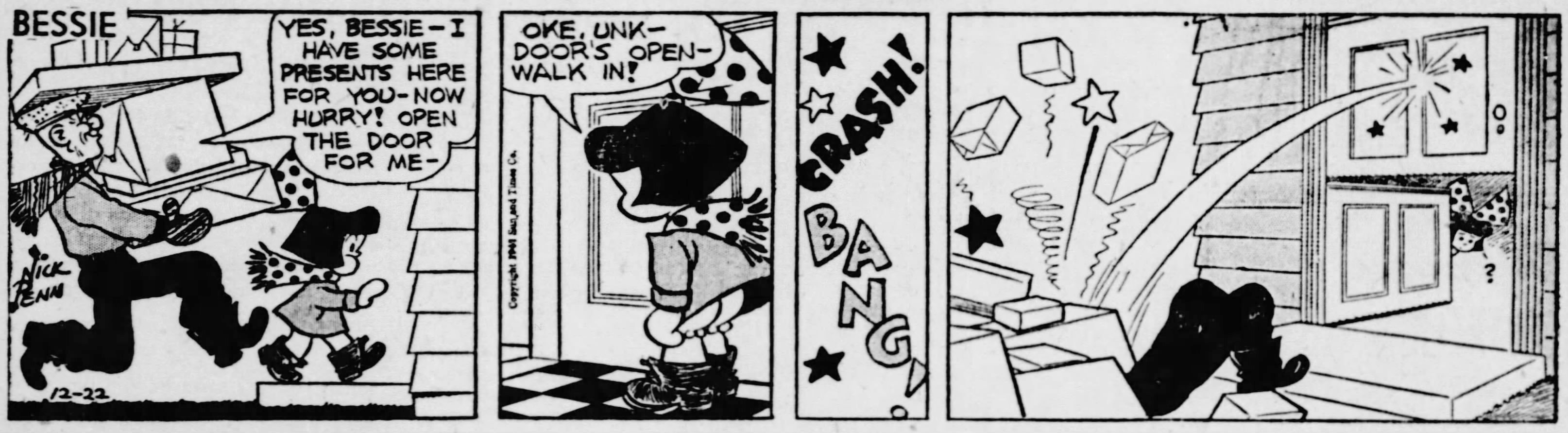
Bessie, December 22, 1947

Bessie, December 22, 1947

Click the image to see a larger version.

Bessie by Nick Penn is another comic strip obscurity that I couldn't find much information on. It was originally titled "Uncle Dudley," who I assume is the "Unk" trying to carry all of the packages in this example. It seems to take several cues from Nancy, being about a little girl that lives with a glamorous woman (Lana Jane), has a friend "from the wrong side of the tracks (Orson)," and who is a bit tomboyish The characters may potentially have been pulled from real life, or perhaps just the names, given that Penn's sister's name was Bessie, and Orson's last name was Pouletsopoulos, which sounds similar to Penn's real last name, Pouletsos. It ran from 1946-1948 under its original name, and from 1948-1950 as Bessie.

It's interesting that Bessie has her own half-door that she can use to go in and out of the house. I wonder why a child small enough that she can't reach the doorknob of a regular door would need to go out so much on her own. But then again, I never really understood how that worked with Nancy either. She always seems to be going all kinds of places on her own without her aunt Fritzi. Those were different times, I guess.

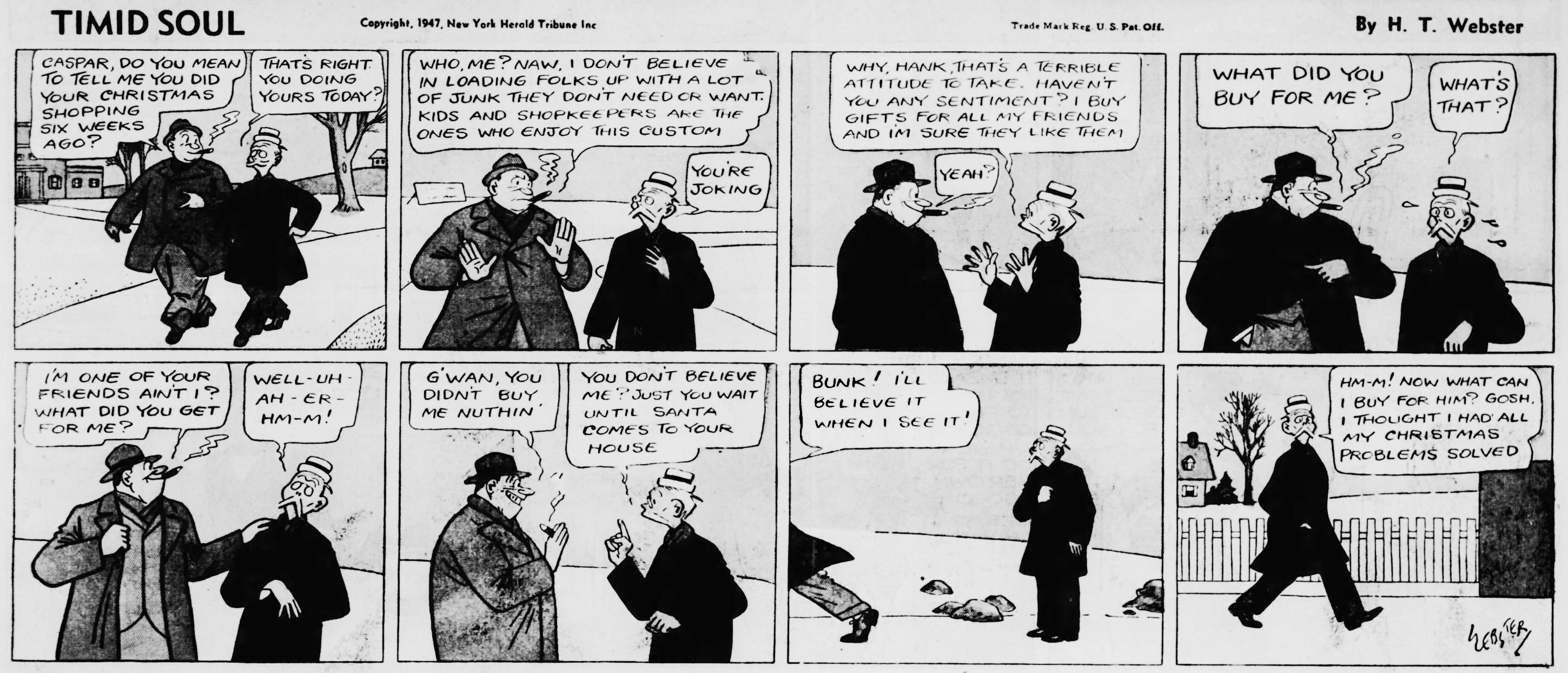
The Timid Soul, December 21, 1947

The Timid Soul, December 21, 1947

Click the image to see a larger version.

I always love returning to Caspar Milquetoast, because I feel a certain kinship with him. While I make gifts for my family rather than buy them, I have found myself woefully unprepared for Christmas in the past, so I try to make sure to get all of them completed and sent out as early as I can. Given the date of this comic, it seems that Caspar bought all of his gifts at the beginning of November. That seems a bit early to me, but I started making my gifts this year at the beginning of November, so I guess I can't judge.

Further, I think Caspar can be excused for not buying his "friend" here a present. Since he's not into gift giving, Caspar may have assumed he wasn't too keen on gift receiving either. Or maybe he's just not as good of a friend as all of the other people on Caspar's gift list.

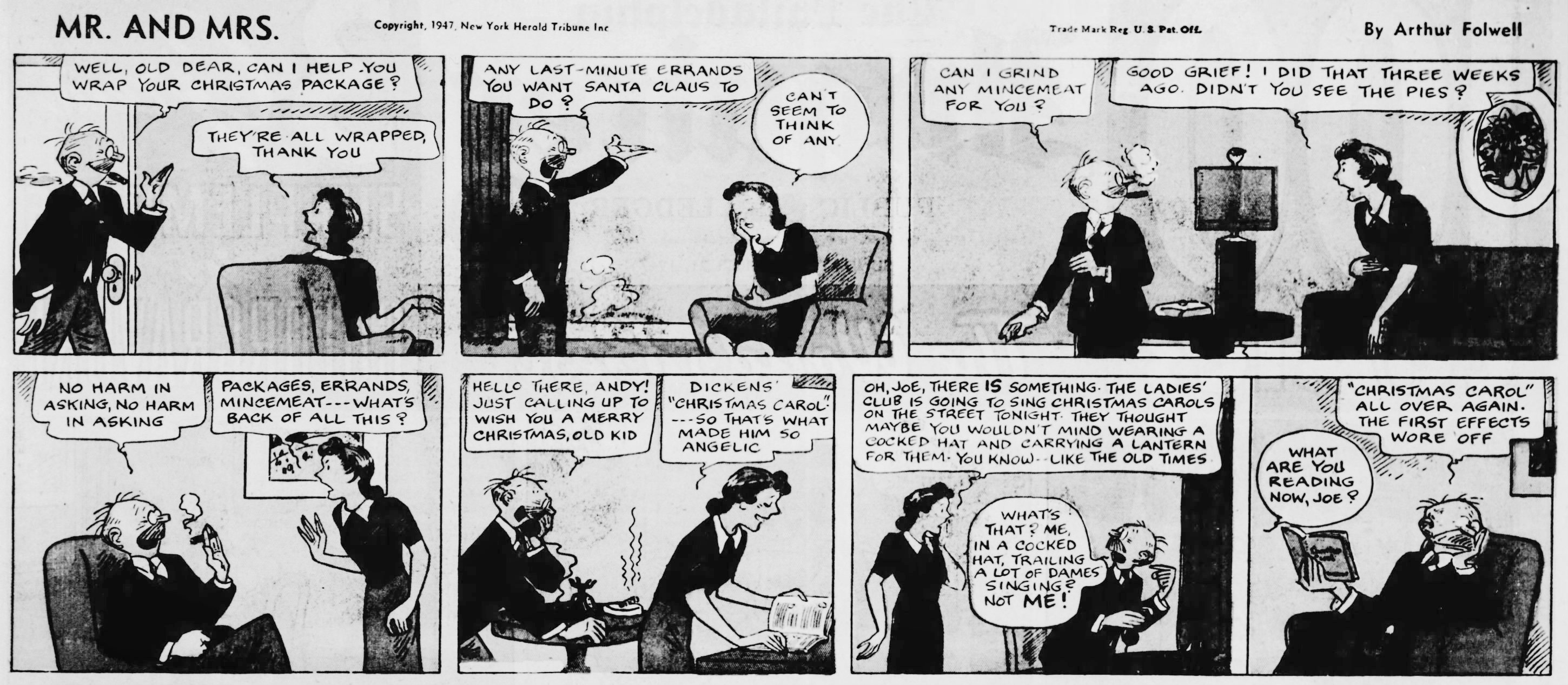
Mr. and Mrs., December 21, 1947

Mr. and Mrs., December 21, 1947

Click the image to see a larger version.

It looks like Mr. has taken Thornsby's advice from yesterday and read A Christmas Carol, which has transformed him into Ebenezer Scrooge from the end of the story, although only briefly. If the effect has worn off, perhaps Mr. could take some inspiration from some of Dickens' other Christmas books. Specifically, "The Cricket On The Hearth" centers around a husband and wife, so it may help him improve his relationship with Mrs.

Thornsby, December 5, 1974

A cartoon drawing of a man and woman walking past a store window display with signs reading "HURRY HURRY HURRY, Time is running out" and "Only 3 Weeks 'Til Christmas, so SPEND SPEND SPEND". The man says, "Let's just go home, light a fire, and re-read 'A Christmas Carol.'"

Click the image to see a larger version.

Thornsby was a single panel comic that ran from 1973 to 1975. It seems to be a bit of an obscurity, as I wasn't able to find out much more than that, even from my usual obscurity sources. What I did find, however, is that Tom McLaren, the son of Thornsby cartoonist Fred McLaren, has collected all of his father's work together into a book, which is available for purchase as print-on-demand on his website or directly from Lulu.

Looking at this panel in particular, it certainly seems like not much has changed in the 50 years since this was published. I think we could all do with a reread of A Christmas Carol. In fact, I think everyone needs a little more Charles Dickens in their life at any time of year (and here's a good place to start).

Our Boarding House, December 1, 1957

Our Boarding House, December 1, 1957

Click the image to see a larger version.

Last time I posted Our Boarding House for Christmas was way back in 2016, so it's high time for another one. Previously, Major Hoople was attempting to earn some quick holiday money by exerting as little effort as possible, and it seems he hasn't changed much in the 27 years between these two strips. Before, he tried to pawn a pocket watch with no success, but somehow this time he's been able to pawn a banjo and a moose head. Perhaps the pawn shop owner is feeling a bit more generous this year. Or maybe it's just a different owner.

Tell It Like It Is, December 2, 1974

Tell It Like It Is, December 2, 1974: A woman is sitting at a desk holding a piece of paper, and there are a large number of cards on the desk. A man is standing next to her. The woman says, "I'm updating our Christmas card list... Several of the 'Mrs's' are signing as 'Ms.'"

Click the image to see a larger version.

Ralph Dunagin was an editorial cartoonist for the Orlando Sentinel who also worked on a few syndicated comic strips. He wrote gags for "Grin and Bear It" and wrote for "The Middletons," and he also wrote and drew his own syndicated comic. Originally titled "Tell It Like It Is," it was eventually renamed "Dunagin's People." While never overtly political, it still touched on various social issues of the day.

I picked this one because it feels very much like a comic from 1974, given the popularity of the title "Ms." at that time. I also really like the ambiguity of the gag. As "Ms." is meant to not indicate marital status, it could be that a number of these women have just chosen to utilize a new title for themselves, or it could be that their marital status has changed. Being able to understand a joke on multiple levels is always an indicator of a well-written gag.

Henry, December 1, 1957

Henry, December 1, 1957. A comic strip that begins with a boy looking at a thermometer with a very low reading. The boy breathes out and he can see his breath. He runs to his wallet and dumps out some coins. He takes the coins to the candy shop and buys a candy smoking pipe. The man at the candy counter says to a policeman standing beside him, "Every time the temperature drops to freezing I get a run on candy cigars and cigarettes --- I don't understand it!" The policeman gestures that he should look outside. The boy and his friends are standing outside the candy shop pretending to smoke with their candies and their cold breath.

Click the image to see a larger version.

Henry is so ubiquitous when I'm searching through old newspapers for winter and Christmas themed comic strips that I was sure I had posted him in a previous December. After searching through my prior posts, however, I found that not to be the case.

Henry is often known as a pantomime strip, because the titular character doesn't speak and neither do some of the other characters. This is not true of every character, though, as we see here with the candy shop man. The strip was created by Carl Thomas Anderson, and continued to be credited to him even after his death. Anderson died in 1948, and the Sunday version of the strip was taken over by his assistant, Don Trachte, who did the strip you see here.

It seems kids of every era were doing whatever they could to mimic adults and act more "grown-up." Back in the days when cigarettes were advertised on television, if this strip is any indication, pretending to smoke was a popular thing to do. I sure hope they didn't take up the real thing when they got older, though.

Cicero's Cat, December 5, 1965

Cicero's Cat, December 5, 1965

Click the image to see a larger version.

Cicero's Cat began as a topper strip to the venerable Mutt and Jeff. The character of Cicero was the son of Mutt, and the topper originally focused on Cicero himself. The cat, named Desdemona, proved to be more popular than her owner, and eventually the topper was focused entirely on her. In fact, she proved to be so popular that often the topper would be printed separately, apart from Mutt and Jeff, though it never officially became its own strip. Since Desdemona doesn't speak, or even "think speak" like Snoopy or Garfield, it also became a pantomime strip as can be seen here. Mutt and Jeff was created by Bud Fisher, though Al Smith often assisted, and upon Fisher's death in 1954 Smith took over both the main strip and the topper.

I've never lived anywhere near any kind of pond or lake that regularly freezes over in the winter, so I've never been out on ice like in this strip, but even if I did I don't think I would be brave enough to press my luck like Desdemona does here. If she had just done some ice dancing on the lake then perhaps she would have been fine. Unfortunately, you know what they say, curiosity about the sturdiness of ice dumped the cat into freezing water (or something like that).